Excerpts from Portrait of a Runner
Davidson Mesa
Some seek the comfort of their therapist’s office, others head to the corner pub and dive into a pint, but I chose running as my therapy. ― Dean Karnazes
 You can pause on the edge of Davidson Mesa and look down into Boulder Valley and imagine its history. It is filled with repeated flooding and receding oceans, intermittent deserts, migrating glaciers and mountains pushing up from old Precambrian rock. What’s been left is a striking juxtaposition of the Rocky Mountains and the Great Plains, tilted sedimentary rock, and a time gap of nearly 1.5 billion years that you can place your finger on.
Mostly, when I run, I just hang out with what comes my way. Sometimes I bring with me the weight on my shoulders, and since weight isn’t easily carried when you run, and since I’d rather run than carry it, it sloughs off, I let it go. There is nowhere I’ve felt that more than on Davidson Mesa.
I wish I could find words to describe the vastness of that mesa. It is usually covered in waist-high blond grasses, and it overlooks the broad, flat valley with the Front Range as a backdrop. That immensity, that vastness, can capture and hold for you, or let go for you, whatever it is you need. My soul at times needs a place so vast.
Tears don’t wash away easily in my small window-poor townhouse. So I carry them to the mesa. The mesa accepts sorrow, and it carries it away for you. Tears disappear across the flatness, up and down the Front Range, into the ocean of the expansive sky. You can see so far up and down the Front Range of the Rocky Mountains that it is not the mountains that end, just your ability to see them.
Beautifully, thankfully, the mesa does not dissipate joy. Instead the mesa respects it, honors it, celebrates it with you, particularly when it is too big for one person to hold on to.
I once found myself in the parking lot stopped, stunned, with a random band of runners, dog walkers, and halted drivers. A lightning storm flashed up and down the entire Front Range, but it was so far away we didn’t feel a drop or hear a sound. Jagged streaks of lightning flashed easily a hundred times a minute across the entire periphery of those mountains, turning the band of sky between their serrated silhouette and the ominous black clouds above a dramatic purple.
There are a number of trails on the mesa, most of them wide and flat and dependable. I’ve extended my runs up to three hours there, meditating my way around and around one two-mile loop. My default is a three-mile course, and I don’t need a watch to know how long I’ve run. I sometimes get lost in the clouds on that mesa. If you’re an appreciator of clouds, you know that from a mesa you can see an incredible array all at once, from white to black and shades of gray in between, from wisps to walls of them. Sometimes I worry I’ll trip because I’m craning my neck so many directions to take tthem in. 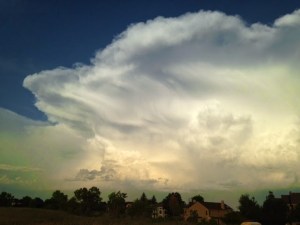
My car has been the first in the lot at five in the morning and the last at 10:30 at night, and though there often aren’t many–or any–people, I can usually expect to see chirping, cheering prairie dogs or bunnies dashing behind yuccas. In the summer, when I’m lucky, I might get to see a sunning snake stretched across the path, absorbing as much heat as it can. At dusk I might see a silent, still coyote only yards away, or a bit later I might hear the eerie howls of a pack. I know those trails well enough to avoid the prairie dog holes when it’s so dark that I have to navigate using more a sense of the trail than sight of it. I sometimes carry a headlamp to use if I get spooked or in too dark, but I rarely turn it on. I trust that mesa. I trust the time it has seen, the shaping of the mountains before it, the broad, flat valley at its base.
My First Marathon
We are different, in essence, from other men. If you want to win something, run 100 meters. If you want to experience something, run a marathon. — Emil Zapotek
Ironman Florida. Extreme gusts of wind had had me awake and terrified in the nights leading up to the race. The winds were no longer howling the morning of the race, but perhaps it was nature’s way of foreshadowing. It was a hard day.
I was about an hour into the bike leg of the race, after a long, choppy, salty swim, and despite already pushing about as hard as I could, I did the math and realized that if I continued at that pace, I wasn’t going to make it in before the 5:15, sundown cutoff to be off my bike. I settled in and gave that ride everything I had–I gave a fight at every pedal stroke. By the midway point, at 56 miles, I calculated that I would need to complete the second half of the bike segment 45 minutes faster than the first. A lot of elements factored into the reason I might not “get” the chance to begin that marathon as the sun set, including wind, sand stuck in my cleat from a bathroom break that made it impossible for me to click back into my pedal, and, frankly, not enough time in the saddle leading up to the race.
I was vastly alone, despite being surrounded by 2,000-plus athletes who were enduring the same miles, the same conditions, and for many people, similar challenges and doubts. I had to draw on my own hundreds of hours and thousands of miles of training. I was low, feeling defeated, berating myself for the obstacles that I could have prevented, and frequently pushing back tears, trying to shift my perspective, my response to my circumstances. With an Ironman, you expect that multiple things will go wrong, and here they were. But while I could have been just knocked out of the race by something like an accident, these things were also not just a flat tire or a long port-a-potty line. There were small pockets of cheering crowds along the 112-mile course, but deep down, my mental strength could only come from my thousands of miles on the bike. Lots of sweat, lots of dirt. Lots of doubt, and lots of carrying on.
That strength is the Little-Engine-That-Could, try-try-again strength. That fighter in the corner of the ring, dizzy and bloodied, standing up again. I sifted through my head for the wisdom I needed. Reminded myself that I had accomplished something big even if I didn’t complete the race. Reminded myself that stressing and worrying would not make me faster. That I couldn’t be a victim. That I was strong and had conquered many challenges in training, many challenges in my life. I knew the value of believing in myself–that belief can make or break such an endeavor. And in the desperate searching for a rope to hang onto, the words of my friends came to me, words of wisdom I’d received as people had wished me luck back in Colorado. I remembered two pieces of advice, and I’ve remembered them many times since. My friend Bonnie said to me, “Shannon, enjoy every minute, even the bad ones!” Yes, there were some bad ones, just a few more than I had anticipated! And my principal, Pat, had looked me in the eye (we’re the same height, and so her words came straight across to me) and said simply, “You’ll do your best, and that’s the best you can do.” Those were the words I was searching for. The words that gave me the grace to relax, knowing that I was doing my best. I didn’t need to ask more of myself than that. I had been doing my best every minute of that race. That 5:15 deadline was still coming too soon, with too many miles to cross, but I was doing my best. Somewhere along the line, after multiple stops to dig sand from my cleat, I was also able to click my shoe back into my pedal.
As the hours went by, I was not so alone. There was a group of us, passing each other as the incline, the wind, or the moment shifted, and there was one man in particular who became my companion. We passed each other frequently, and it was purposeful. You’re not allowed to ride within a few bike-lengths of someone for more than 30 seconds, and once you begin to pass you must finish the pass to avoid a time penalty. But our frequent passes, probably every five minutes, allowed 10-15 second fragments of conversation that linked together, linked us together in common cause, and we became the support that we needed. I learned about a swim he had done to raise money for a farmer, four miles across waters that churned like a washing-machine. At the time I could have told you more, I could have told you my friend’s name, the color of his jersey; I remember dark hair, I remember he was about 10 years older than me. I remember that we talked about our fears, our hopes that we wouldn’t be mourning a run that never got started. Out of the group of us who were chasing that 5:15 cutoff, I know many did not make it. I did make it, I crossed the line at 5 o’clock.
As my new friend and I became confident that we would be gliding in with at least a few minutes to spare, we were so relieved. We relaxed–we were ecstatic. More than seven hours of cycling, as hard as I could, after that draining, stressful swim, and I was finally able to settle in and enjoy the ride. My companion, coming up from behind, smiled, gave a wink, and said, “Hey, if you’re not doing anything later, want to run a marathon?” I was so thankful to get the chance to embark on that run, and I was so thankful to have that shared experience–my companion felt that same agony and relief, the same joy, over those same hours. It didn’t occur to me that one of us might make it and the other not, because we’d become a leap-frogging, empowered team.
I pulled into the transition area, and one kind volunteer grabbed my bike from me while another ran up with my transition bag, pulling out my things for me. I took a luxurious 10-minute transition, changing into running shorts and cleaning my contacts, and then I set off on my first marathon.
18 Degrees: A Swimming Pantoum
I crunch fresh snow against concrete in my flip flops
curtains of steam rise, shift, curl from the water
a snowman, armed with goggles, snorkel, and fins, stands watch tonight
my cold nose warms up, thankfully submerged
curtains of steam rise, shift, curl from the water
as snowflakes cascade, a quiet deluge
my cold nose warms up, thankfully submerged
in 30-second rhythms, I flip and turn
as snowflakes cascade, a quiet deluge
in the light’s orange glow that flirts pink with the purple dark of sky
in 30-second rhythms, I flip and turn
a slight cone of snow builds on the globe of light
in the light’s orange glow that flirts pink with the purple dark of sky
a few thousand strokes tonight
a slight cone of snow builds on the globe of light
bursts of white-gold glimmering bubbles tumble upward, clamoring toward escape
a few thousand strokes tonight
the tingle of snowflakes thrills my skin, my tongue as I turn to breathe
bursts of white-gold glimmering bubbles tumble upward, clamoring toward escape,
thundering underwater
the tingle of snowflakes thrills my skin, my tongue as I turn to breathe
I pause, turn toward the pool, and take in the silence
thundering underwater
then draw back into the water, the cadence
I pause, turn toward the pool, and take in the silence
elusive rays reach out to play in the steam
then draw back into the water, the cadence
how can such a torrent create such a stillness?
elusive rays reach out to play in the steam
a thin layer of snow pellets has gathered on my flip flops
how can such a torrent create such a stillness?
how can it be so quiet when the sky is falling?
a thin layer of snow pellets has gathered on my flip flops
that pale chlorine-blue is broken by thin veins of waving, fleeting gold
how can it be so quiet when the sky is falling?
I can only see clearly underwater
that pale chlorine-blue is broken by thin veins of waving, fleeting gold
a snowman, armed with goggles, snorkel, and fins, stands watch tonight
I can only see clearly underwater
I crunch fresh snow against concrete in my flip flops
 Learning the Language