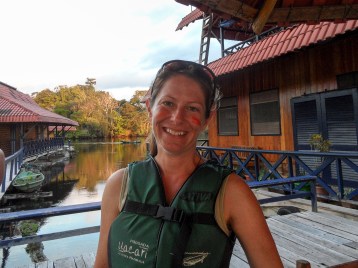
 With the plight of the Amazon so prominent recently in the news, I’ve frequently reflected on my short time in the rainforest in late July of 2014. I wrote about it at the time but never published it. Rereading it now, I’m reminded of the intense peacefulness I experienced while there, surrounded by water and trees and birds, sounds of monkeys, glowing eyes in the night. Indigenous people I was lucky enough to learn from. It was not only a different pace, but a different sense of time. Looking back, I’m amazed that I was only there for five days, as I’d stepped (or floated) into another world. So here’s my little ode to the stunning Amazon forest.
If you are interested in learning more about the current state of the Amazon rainforests and how to help them, see my notes at bottom. There are a couple of great articles about our food choices, in particular.
Tuesday, midday
I’m sitting on the porch in the middle of the world’s largest floodplain, an area the size of England.
Right now I can hear the disconcerting howl of the red howler monkey. I don’t know how to describe it except that it sounds like an enormous, ominous monster (the croak of a giant frog?) straight out of The Lord of the Rings. It seems far in the distance, there’s an echo quality to it. One person thought it was the howling of a ferocious wind, but he realized the air was still when he walked outside his hut. When the howler monkeys quiet down, there are so many layers of bird and insect noises.
I am at Pousada Uacari (wa-ka-DEE), named after another, rare, monkey found only in this area. Uacari is the only spot that tourists can stay in all of Mamirauá (mom-EER-a-WAH), which was established in 1996 as the first sustainable development reserve in Brazil. Uacari sits on the curve of a U-bend on the Mamirauá Channel just before the junction of the Solimões and the Japurá Rivers, tributaries to the Amazon.


The ecosystem is called varzea (“flooded”) forest. Between the dry season and flood season the water level varies by 12 meters, and the current level, a meter below the high, is dropping. The lodge, five huts, and walkways between them are all floating. We are floating at the canopy level, and the only way to get around is by boat.


There are a dozen of us staying here, and we have breakfast at 6:30, followed by a morning activity (this morning we visited a local community), lunch and rest to avoid the heat until 3 or 3:30, and then we head out again, today by canoe into the canopy. Most nights there is a boat ride or talk with a researcher after dinner.
To get to Mamirauá you fly to Manaus, the big city of 2 million on the Amazon, then take a one-hour flight to the tiny Tefé airport, which has two flights in and out most days. (Or, like six of my new companions, you can take the day-and-a-half boat upriver from Manaus and pay for a cabin or buy a hammock to sleep in. I’m told a local woman offered manicures on the boat, her husband showing various manicure options on his phone.)


Depending on how you count, there are well over 1,000 tributaries to the Amazon (17 are more than 1,500 km long), and in some places the meeting of the waters is dramatic. The meeting of the waters in Manaus is a destination in itself, where the Rio Negro meets the Amazon, or the Rio Solimões. Tefé is on a lake of black water, and not long after we left the port that connected us to civilization, we crossed from the black water to the brown of the Japurá River. We paused there, and I got my first show from river dolphins, who commonly hang out at the meeting of waters because fish are plentiful. The speedboat then transported us up the Japurá for an hour and a half to our lodge.
The lodge is designed for minimal impact, using solar power for lighting and water heating, rainwater collection, and a sewage filtration system. We’re in the depths of the Amazon, and yet midday inside the lodge are half a dozen cell phones and cameras charging off the solar electricity, and here I am with wifi—I Skyped with my dad today to show him around.*
There is no light pollution, and there has been no moonlight. At night, the only light we see has traveled years, and trillions of miles, to reach us in this moment. Inside the hut it is pitch-black. In addition to the various creature sounds at night, the sound of the strong current weaves underneath the hut. Last night I was in a deep sleep in the dark night when a “tempest” came down upon us. I woke with a terrible panic with the storm. I gasped and clawed around under my mosquito net trying to bring myself back to reality, but between the current below and the deluge everywhere else, it was hard to find a center hold on to. The flashes of lightning just made me feel like a small ship in a giant storm. But my hut was still secure come sunrise, and apparently I was not alone in my panicked reaction to the storm. We all now feel a bit seasoned and maybe ready for the next dead-of-night tempest.
A gray dolphin is now surfacing out in front of us. One of my companions has been teasing that I should easily be able to swim to the canopy across from the lodge. We’re not allowed to swim mostly because of piranhas and caimans, but Dieter claims that fleeing an alligator will improve my swim times. I think I might not only swim faster but possibly even manage human flight should I face a caiman at eye level.


Wednesday
It’s a wonderful thing to wake up with a stiff neck from craning so much to peer at the birds, the monkeys, new friends behind you in the boat, the stars. No tempest last night (I was a little bummed, I wanted the chance at bravery this time!), and we all slept well.
Yesterday morning we visited Boca do Mamirauá, a local community. We talked for a long time with Antonio, a 78-year-old man who has lived in the community since he was eight. He lost his mother, during childbirth, at the age of nine, and that loss halted plans to move back out of the submerged community. Antonio has had two wives, and he says he does not have many children. (He has 12.)
Antonio told us stories of caimans snatching dogs and chickens and of piranhas taking bits of fingers, and he answered our countless questions about farming, water, and life in a world that is flooded half the year. (The residents much prefer the dry season.) We asked about the watermarks on a relatively new home. The two lines, well above floor level, represented the high water marks for the last two years. This past year Antonio lost a freezer to the flood because there was no one around to help him move it above the water level. Antonio showed us both the skull of a jaguar and the ball-of-hair “poop” of a snake.


We were able to pop in on the community school, where a teacher works with 18 students up through 4th grade, and about half of them were in attendance when we visited. The school is named for Joaquin, a 75-year-old man whom we had the opportunity to meet. We also visited a shop featuring mostly jewelry made from local seeds (like açai), and we got to see the powerful pink color obtained from a smashed berry.


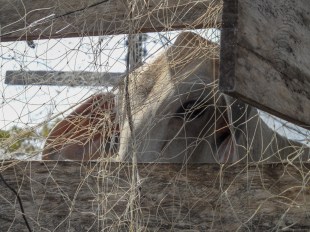
A cow resides in a small wooden (floating) cage that is netted to protect it from vampire bats—not the existence I would wish on anyone. Drying laundry included a pair of U.S. flag boxers. The wooden goal posts demarcate a submerged soccer field. A small array of photovoltaic panels floats on a log. Our local guide paused at a plant to gather seeds as a remedy for our primary guide, Aline, whose eye had been bothering her since a bug had lodged itself in it a few days prior.


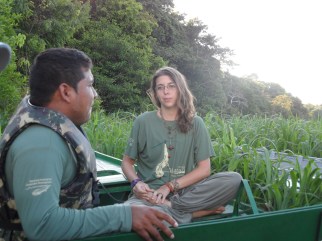 Aline, young and sweet and knowledgeable, has an incredible eye for identifying birds. It turns out it’s her specialty—she’s just finished her degree—but her talent is impressive regardless. She told me that she had gone to an eye doctor to improve her vision. The doctor laughed and said that she has near-perfect vision—what she was asking for was the vision of an eagle. 🙂 I’ve always enjoyed birds but been too frustrated by bird guidebooks to make sense of species; it’s really something to have a human to talk me through the identifying! I was lucky—because I was traveling solo I often sat next to Aline when we went out as a group (though the couples were so friendly and always offered to have me sit with them), and so I had first-class access to her knowledge, and she was immensely patient with my questions.


Aside from Aline, who speaks both English and Portuguese, all the guides, cleaning staff, and cooks come from local communities. Work at the lodge is coveted, and so aside from one manager, the locals rotate each week.
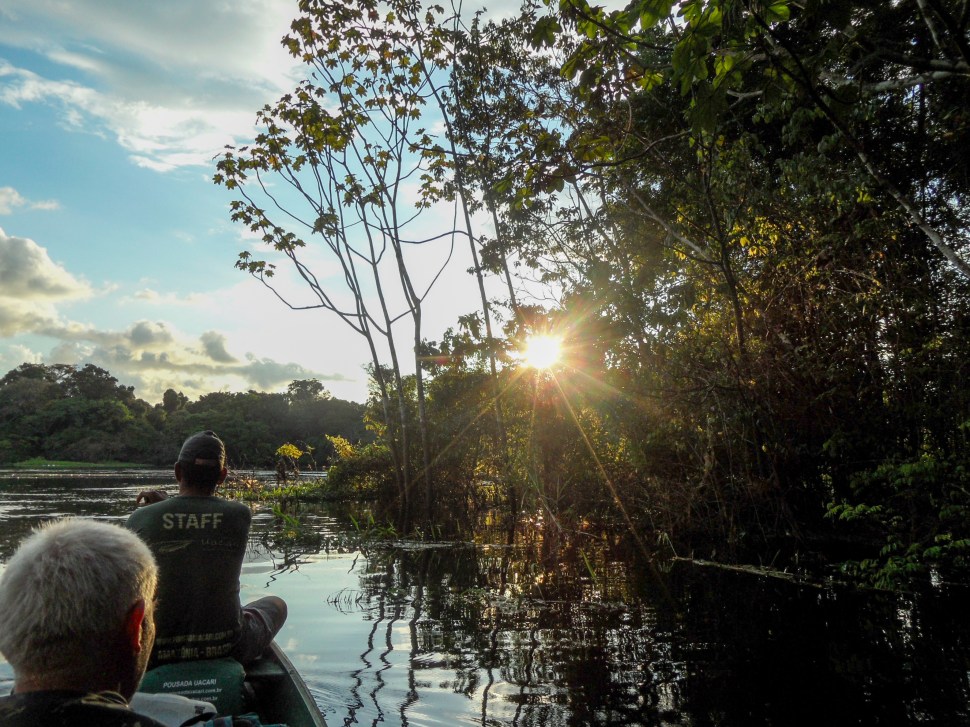
Yesterday afternoon, armed with my camera, binoculars, and insect repellent, I headed into the tree canopy in a canoe with Ray, an Englishman, and Ray’s guide, who answers to “Padre.” I find it so interesting how a small crew such as us comes together. We represent three continents, know almost nothing about each other (Padre doesn’t speak English), and yet we spent an intimate couple of quiet hours paddling softly through the canopy, seeking monkeys and pointing out birds. There was an occasional thwap as Padre smacked his ball cap against black flies and mosquitoes. The other lone traveler at Uakari, Ray also frequently became my boat-mate. He turned out to be a fabulous guide for me; he knows his creatures, and he arrived a few days before me, quickly developing a sense of the area. It was also nice to share a boat with someone else whose first reaction upon seeing a spider is to study it, and then to rescue it should the need arise.


Green tendrils hang down from trees, and branches and trunks wind and connect in all sorts of patterns; some of the thin branches are so curvy they make me think of a green, wooden, stretched-out slinky, and some of the windy branches have even more squiggly woody growth wrapped around them. I was surprised by the variety of trees that protected their trunks with spikes of all assortments—ringed, clusters of fans, and even those that took the form of bumps but were sharp enough to elicit a gasp and a reflexive yank of the hand. The sun makes its way through the dense canopy in bits, backlighting spider webs and turning light-colored spiders translucent. The sun behind the common spider monkey gives the light brown fur a sweet aura, with blond highlights.


The black-headed squirrel monkey (endemic to Mamirauá) often sounds like the soft chirp of a squeeze toy. The squirrel monkeys are fantastic. Both the common and black-headed squirrel monkeys are tiny, and they are always in bunches. You turn your head this way and that, sometimes straight up, as they make a raucous thrashing through the trees, frequently sending bits of branches and twigs plopping into the water. You’ll see one of them, thin arms and legs leaping spread eagle into one flailing branch and then another, followed in a line by its springing comrades. Then they’re running nimbly along limbs and giving you that iconic silhouette of a monkey scampering up a tree that we love so much. They don’t pause for long, at least not when I’ve been watching. It’s such an interesting way of moving about the world. It looks like such a blast.


We headed out by speedboat at eight last night, long after the sun had set, and we were out for a couple of hours. The night sky was so clear that you could not only make out the Milky Way but also discern variations in its density. The stars were mirrored in the water, in a wobbly, sort of surreal version. We sped along, a guide at the front quickly scanning from one bank to the other with a large spotlight, looking for the reflection of eyes. The night eyes are incredible, a pair of bright iridescent orange lights shining out from the canopy, or from the water, in the case of a caiman. The few fireflies I saw had a different flight pattern than I was used to (like that of a dragonfly on the move), and their flashing was less like a slow strobe and more like Morse code. Mostly, there was darkness, and it was such a rich adventure, heading upriver in the Amazon at night.
The nighttime air was thick and sweet and a beautiful temperature, sometimes the slightest bit cool, which we relished. We got to see a nighthawk and a large fishing bat, which has a yellow belly. When the guide shined the spotlight on a potoo, a large bird that blends in perching high atop a bare tree trunk, the bugs that swarmed the light were so many that Ray suggested it was like a blizzard. Not only that, but they flew in such a frenzy that their patterns remained in my vision like an incredible mini meteor shower.
Not long after, necks craned, we witnessed a few real meteors—those bits of dust and rock that burn so brightly as they enter Earth’s atmosphere.
***
If you live in the Amazon’s floodplain and you don’t live in the water (or floating on the water, in our case), you live in the trees. The king of the food chain, the jaguar, lives in the trees but swims well—yikes. Another species of note is the manatee, for which the reserve is named (“Mamirauá” is an indigenous word for baby manatee). Almir, a guide, pointed out floating greens that the manatee feeds on.
Some of my companions were lucky to see two types of rats, the bamboo rat and the spiny tree rat, which Ray said was about a foot long. Fortunately no one encountered the candiru fish, which, as legend has it, has been known to follow a stream of urine to the source and lodge itself into people’s urethras, even reportedly swimming up the stream of urine of a man relieving himself off the side of a boat. (The parting advice from my dad the night before I left for Brazil was not to pee in the water. None of us did, and our urethras all made it through sans invasion.)
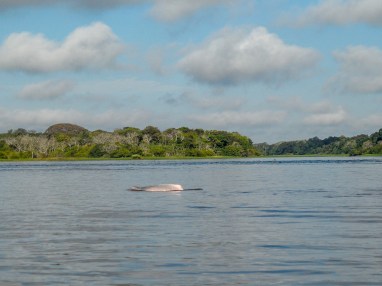 Then there’s the boto (“bowtu”), the pink dolphin. There are both pink and gray (tocoxi, pronounced “tocoSHEE”) dolphins in Mamirauá. One night we listened to a talk from a young researcher from Spain who lives in a house with a colleague just upriver. She told us many ways that the pink dolphin varies from the better-known gray river dolphin, which was small, but otherwise looked like a marine dolphin. The boto has a “melon” atop its head which it can actually move to echolocate in the extremely murky water. The researcher showed us a boto skull and explained that the boto is much more agile than hydrodynamic, and it can maneuver its head into hard-to-reach places. There is an unfortunate legend of the boto in the local culture. According to the legend, the boto will leave the water at night and dress up as a man, with a hat, and get a woman pregnant. This legend accounts for “unexplained” pregnancies in the area, and the botos suffer the consequences. We saw a haunting photo of a mutilated boto, its tail tied and words that had been carved into its side before it was released back into the water.
Though the researchers are in Mamirauá to study dolphins, they have other creatures to contend with. Thanks to termites, their house is slowly sinking, and the two women can tell by the smell when the resident caiman is hovering below the house.
Fun fact read by Piotr and Kristina, a Swedish couple, in one of the many books available at the lodge: Capuchin monkeys are “often implicated in the theft” of the brightly colored metal labels off the trees, because they are so curious and so dextrous. Says Piotr, “It seems they have something in common with us, we also do perfectly irrational things.”
Before I turned in last night, I could see the smallest sliver of a new moon. I didn’t know this, but I’m told a new moon is good for a wish.
***
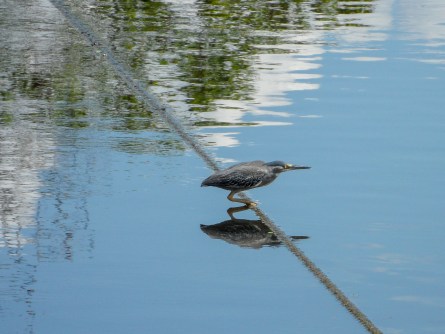
As I sit on the deck of the lodge, lizards scamper along from time to time, a large frog hangs out at night, and a sweet skinny bird (some type of heron?) tight-rope walks a thick rope tethering the lodge to the forest. Hanging out (attempting to type) in my hammock on my porch, a tern swoops down in hope of a meal. Though the lodge and huts often float quietly as the current moves past, there is at times a good bit of creaking and moaning as the walkways and huts shift, sometimes sounding like a low groan from the fifth grade brass section at the school where I teach. At times, atop the noise of howler monkeys, we have howler walkways.
***
This afternoon we headed out at 4 p.m. by speed boat to Lake Mamirauá. At times I enjoyed lying back with the boat zooming along, closing my eyes to just let the sun shine through my eyelids and breathe in the breeze created by the boat.
By this time we were accustomed to floating in the tree canopy, with the crowns of the trees still towering above. But in Lake Mamirauá, the last bits of branches and leaves of trees reached just a few feet above the water like little islands. On the lake we had an expansive view that reminded us of the African savannah with the trees on the horizon. Instead of the rolling yellow land of Africa, we had the water of the Amazon.


We parked in one of these crowns of trees and watched the sunset as we enjoyed some delicious small bananas, some dense, moist, mildly chocolate cakey stuff leftover from breakfast, freshly cut papaya, and Brazil nuts (of course), though the nutcracker wasn’t quite intact, so the Brazil nut cracking got a little creative. The waxing moon became bright as the sky darkened. We then headed back to the lodge, taking probably close to an hour, and as two guides scanned the trees with spotlights I searched for the reflective eyes. But mostly I watched the stars, studied the contours of the Milky Way, and watched the international space station travel about 250 miles overhead. We spotted a caiman, a very large owl, and another potoo.
***
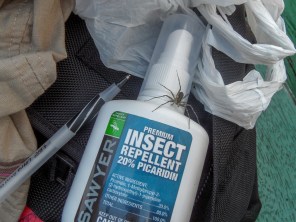 I abandoned my doxycycline, having been told by both Aline and other tourists that our area was malaria-free. I was quite happy to avoid five weeks of killing off a portion of my microbes, avoiding dairy within a few hours of my meds, and being particularly sensitive to sunlight. (I must say, I’m quite happy with picaridin as an insect repellent, instead of DEET.)
The food at Uacari is fantastic. Lots of manioc (a root vegetable) made in a variety of ways (mashed, baked with cheese, fried, and processed into farinha, a sort of coarse flour that Brazilians can’t get enough of). Also lots of fish, beans, and rice (a staple all over Brazil), passionfruit, small bananas, papayas… so much wonderful fresh fruit!
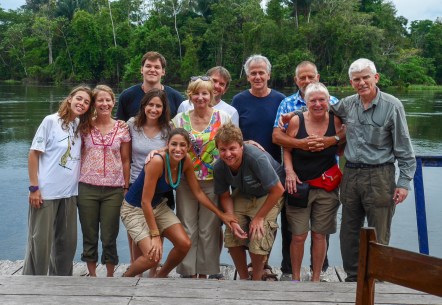
I’m often moved by the sharing of new and profound experiences with people I barely know. You come together for something, one amazing thing, and then head back to your everyday selves. In the brief time that your lives overlap, you not only know a place and a time together, but you also bring together a concoction of histories, of perspectives. We don’t necessarily represent our countries, but we bring those places, the history and stories and chronicles of those places, and our own personal narratives, to the table. (In this case, literally to the table where we shared our meals.) We get into questions of heritage and perspective and politics, quickly anthologizing this crew that we are for five days, trying to better ground ourselves in the shape of the world, reaching beyond learning just this place and just this time. And we school each other in the things we know about birds, the night sky, our experience of the city the person sitting across from us might visit next. And we are often working to find the right words, for while English is the common language among the travelers, it is rarely the first language for the majority. (Of course, we all know that the right words can be so elusive even in your primary language.) This day, in particular, we attempted to resolve differing understandings that we have about Russia and Ukraine. I tried mostly unsuccessfully to convince my companions that in most places in the United States, it’s perfectly safe to walk down the street, and in my town, for me to walk down the street alone at night. International news is hard to undo.
Thursday
When you get to see five species of monkeys in their natural habitat in one day, what more could you want?
This morning Almir paddled just the two of us in a canoe through the tree canopy for almost four hours while the rest of our crew were out fishing. (Natasha passed on a couple of photos, below.)


 The guides can tell you how deep the water is wherever you are, they can make a variety of noises and whistles to call or grab the attention of caimans, sloths, and birds, and it’s a marvel, the camouflaged creatures they can spot. They carry a wisdom of the forest one can only develop by being a part of it, living it year after year.
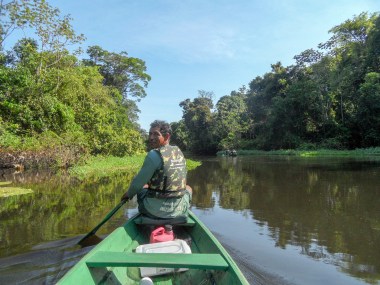
From the front of the canoe Almir spoke to me in Portuguese, quiet enough so as not to disturb the stillness. He rarely paused or turned around enough to see if I understood. I did pick up some, with his miming and despite my limited ear, but at first I felt a little uncomfortable, not wanting to lead him on that I understood when I didn’t, but also not wanting to cut him off. But he knew I wasn’t picking up much, and my discomfort turned into appreciation. I became so touched that he was taking the time to tell me about the birds, the nests, the food chain, the growth of the trees, even if I could mostly only take in the tone of it. And the tone of his steady voice, his reverence for this place, told me plenty. As did his careful searching the of trees and gentle paddling in silence.
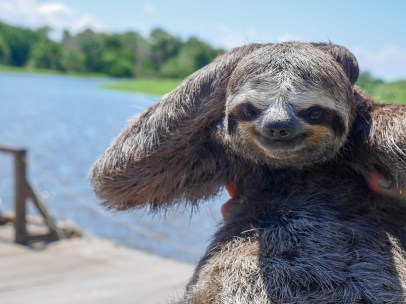
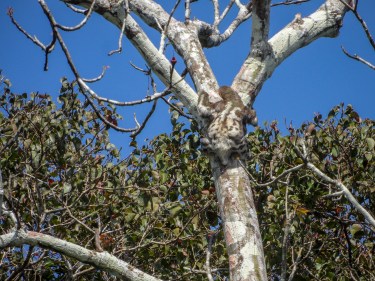 You can probably picture the thrashing way the squirrel monkeys move through the world of a tree canopy, tough for non-native eyes to spot and keep up. (It helps to have a small cadre of spotters spotting and pointing. “There! Another!” “Look! There’s more!”) The way the squirrel monkeys move is pretty much the opposite of the sloth, a creature on the pretty-much-guaranteed-to-see list in our neck of the forest. The sloths, the three-toed variety, are perfectly camouflaged with their mottled white and grayish-brown fur against the bark of the munguba, in which they reside because of the hanging red football-shaped fruit. But because the tree is leafless, sloths are not so hard to spot once you know what to look for—-basically a lump in the tree. And unless you have to paddle back to the hut to grab your camera, you have time to catch a photo. The first sloth I got to see, a female, was carrying a baby.
Almir and I watched a male three-toed sloth make his way, as if through syrup, from his perch up to the top of his tree, use his weight to bend the branch down to a lower branch, and ease back to where he started. The video below shows a different sloth moving from one branch to another.
As we paddled through the canopy the roar of the red howlers was sometimes near, but usually echoing in the distance. I’m going to expand on my description of that sound. Definitely a howling wind, maybe a cross between a lion and a frog; the howling mostly ceases when you get close, but then there’s a touch of grunting pig sound mixed in.
Aside from the sometimes-nearby howlers, we have noted multiple times since we’ve been here that the canopy feels so quiet. But the key word is “feels,” because of course it’s really not quiet at all. There are so many wonderful synonyms for “noise” that fit the forest at times, depending on the proximity and mood of the creatures (I’m thinking mostly monkeys and some birds)… cacophony, raucous, hubub, commotion, bedlam, pandemonium, racket, clatter, clamor, fracas… but sometimes the sounds are just the constants that become background—the soft paddle of the oar lapping at the water, threads of birds and insects chirping and singing and laughing and squawking, the occasional mosquito buzzing in the ear—but it’s peaceful, and we often equate peace with quiet.
The longer you’re out, the further you’re in, the more your senses can perceive your surroundings. I am well into my element, having been in the forest for a couple of days. My eye for movement, for discerning wing from leaf from tail, is improving, and I am thoroughly appreciating all those strands of creature voices, even if I can’t identify most of them by species. I asked Almir to show me a rubber tree, a seringueira, in the forest, and as he showed it to me, he slapped his hand against it, held his hand on it momentarily, firmly. I’m not sure of his intent, but I took it to mean that he respected it as a solid tree. As the canoe moved forward and I placed my own palm against the tree, the feeling was exactly as I expected and yet startling at the same time. By not only reaching out to touch the tree, but by also opening up my palm to its texture, I was suddenly heightening another sense that I’d taken for granted and assumed I knew without actually experiencing it. I’d been tuned in to the feeling of the warm sun and the cool breeze, and the frequent sensation of a tiny crawling creature on my arm. But I hadn’t yet started to learn the texture of the forest, and so I began to gather it. I touched many of the trunks that glided within reach, sometimes gently with my fingertips, but mostly taking a palmful of the roughness, the smoothness, the personality of the tree (always with at least a quick glance for creatures with any number of legs).
Just as I actively opened up the sense of touch, I often closed my eyes for long moments to focus on not only on the refrain of the forest but also the rich composition of scents within reach. That rich forest smell of plants, tree bark, moisture, and soil, touched with a not-unpleasant hint of decaying wood.
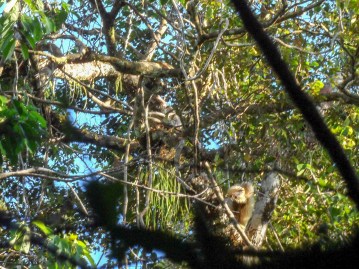
This afternoon I took my last canopy tour with Padre and Ray. The late afternoon sun filtered in as Padre slightly bent a thin branch sticking up out of the water. Toward its tip was a nest the size of my cupped palm, holding two small eggs. The nest had probably just barely held itself above the high water. He showed us how a V would be cut into a rubber tree to drain the latex. Padre spotted a brown tarantula on a tree, for me one of the delights of the trip. (Now I could really say I was in the Amazon!) And we felt successful as we finally saw the elusive yellow, bald-headed and red-faced uacari monkey, for whom our lodge was named. A capped heron graced us with a view and a few dolphins surfaced here and there as we paddled back to the lodge.
Friday
This morning I got a knock on my door just after 5 from Aline saying that the sky was clear, and so I quickly dressed and threw some water on my face, grabbed my life vest and daypack, and headed out with two guides and Natasha and Dieter to watch the sunrise by boat. A lightning storm flashed far in the distance, and as I sat back and rested my head so I could stare straight up, I glimpsed two shooting stars. Venus, Orion, and Pleiades slowly faded into daylight. Clouds moved in, and so we missed the sun, but as we traveled back to Uacari we did have the pleasure of hanging out with both the tocoxi (gray) and boto (pink) dolphins at the same time. They emerged on all sides, and it was delightful to see the two species mingling. We were also treated to many pairs of festive parrots, squawking as they flew overhead, and a nice close-up with a couple of perched toucans. We pulled over to a canoe for a minute for the guides to chat with a friend, whose son, about four or five, held a pint-sized green paddle matching his father’s (and the paddles in our canoes). As we motored off, the boy sat proudly upright as he helped his father paddle away. I think that all Brazilian boys are handed a soccer ball as they exit the womb, and the boys from this area must also be handed paddles.
***
One last Uacari breakfast. It was cool enough outside to eat by the river. We were ending our four days without a foot on land. The same speedboat that had delivered us from Tefé on Monday showed up again—I recognized the same combination of soccer stickers on the windows and “100% Jesus” painted in script on the front.
So there we were on our way out, a bit more subdued this time, and eventually we recrossed into the black of Lake Tefé, exiting the world we’d entered on Monday.
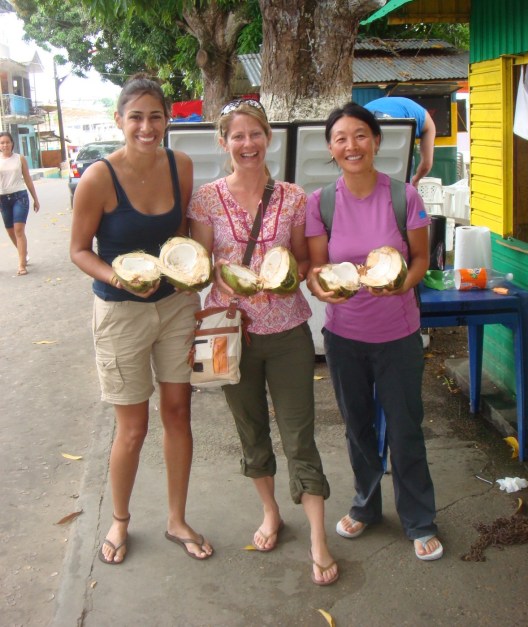
In Tefé, Maria Pia bought me my last Brazilian coconut with a straw, and after we enjoyed the water we walked back up to have the man hack them open with a mini-machete-like-knife.
At Tefé’s tiny airport, we all chatted and waited for our delayed plane, we laughed as we waited for our bags in Manaus, and we started to kiss and hug and say our goodbyes as our paths began to untangle. Aussies Sarah and Kiril kindly offered to store my bags in their hotel room and let me hang with them for the evening while waiting for my midnight flight, and I made my final Amazonian spider rescue from my suitcase as I reorganized my bags.
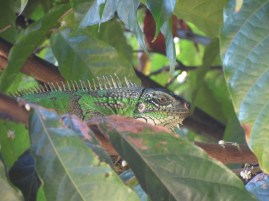 Sitting on the balcony with a beer at their hotel, I spotted an iguana in the tree, at least three feet long. My last Amazon wildlife, in a city of two million. Together with Ray and Dieter and Natasha we enjoyed dinner on a plaza next to the famous pink opera house.
***
When you’re living completely on water, it becomes hard sometimes to sort out what’s moving. You might feel stable but realize it doesn’t make sense that the trees are floating downstream, or that the stars are drifting across the sky at a tangible speed. It was a fun sensation, a realization that it was okay to be in a time and place where reality felt a little blurred. There were things far more fantastical than stars soaring across the sky. So I feel grounded and the forest is floating away—why not?
Does it make sense that this place that takes so much time and so many arrangements to get to, a place full of legend and feared creatures of all sizes, a place with a name so potent… does it make sense that it feels so inspired and so much like home in its connection to the very basics of life on Earth? As I finally finish this journal entry months later, watching frigid, blustering snow outside my home in Colorado, I can feel again the heat, the hammock on my little porch above the flowing river, the thrill of caimans gliding closer, the image of soaring stars. I can feel my eyes lighting up, my heart rate speeds up just a little, and I smile. I feel grounded where there is no ground.
*It’s because of my dad that I visited the Amazon. He’s long been fascinated by and in love with the magnificent river and all the wonders associated with it. In part because my trip to Brazil was so last-minute, a trip to the Amazon felt too costly and cumbersome to plan (especially since most of the tour companies didn’t respond to my inquiries in the midst of the World Cup!). But then I thought, heck, I’ll be right there…
Why the Amazon is so important, and what we can do to protect it
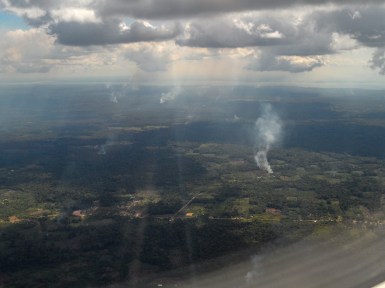
In 2019, there were more than 127,000 fires in the Amazon detected by satellite. President Jair Bolsonaro’s emphasis on economic development and brazen disregard for the importance of the forests has drastically escalated the fires. But it is worth noting that while the fires and deforestation this year have been in the international spotlight, they are unsustainable even at their normal rate in recent years. In 2018 the total number of blazes was 90,000.
For most of us, the Amazon rainforest is a world away, and few will ever find themselves in the midst of its beauty. But the burning of the Amazon affects us all—the health of the Amazon is linked to the health of the planet, and protecting it is among our best defenses in mitigating climate change. Deforestation releases the carbon stored in the forest, and the Amazon forests—considered “the lungs” of the planet—contain somewhere between 90 and 140 billion metric tons of carbon. There is a balance as the rainforests help govern their own rainfall, through evapotranspiration. The destruction of rainforests creates a negative feedback loop, in which increased deforestation leads to increased temperatures, which can both dry out tropical forests and increase risk of fire. As forest is cleared, its exquisite system will unravel, and the climate will increasingly shift toward savannah.
The biodiversity in the Amazon is staggering—one in 10 known species on our planet lives there. We want to keep it that way. Scientists discover a previously unknown plant or animal species every three days. As species become extinct, we lose any potential to learn about them, and we lose any potential benefits, such as medicinal purposes, for ourselves. The loss of habitat will become increasingly catastrophic for animals that have no chance against smoke and flames. (See this Natural Resources Defense Council article about the effects of the fires on jaguars.)
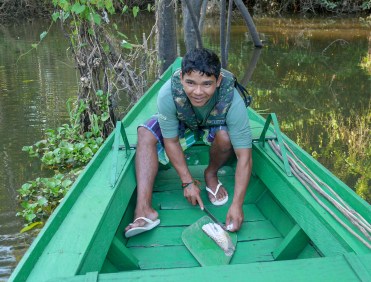
In my journal I focused more on the flora and wildlife than on the indigenous people who call the rainforest home. I have deep gratitude to the people who helped me see one of the most awesome areas on the planet through their eyes, and I have great concern for their future. (Their plight is heightened by Bolsonaro’s openly hostile rhetoric. These sickening comments are among many: “It’s a shame that the Brazilian cavalry wasn’t as efficient as the Americans, who exterminated their Indians,” and “I’m not getting into this nonsense of defending land for Indians.”) There are almost a million people who live in the Amazon, many of whom are at risk of losing their homes, livelihoods, and even their lives.
The good news: While we might feel helpless, there are things that we can all do to make a difference. Approximately 80% of the forest that is cleared is dedicated to cattle ranching, and an additional area the size of Ireland has been cleared for soybean production, the purpose of which is cattle feed. (Meat and dairy account for almost 15% of the planet’s greenhouse gases each year, which is comparable to the emissions from all cars, trucks, airplanes, and ships combined.) The good news part: you don’t need to completely eliminate beef and dairy to make a difference. Could you reduce beef consumption by one or two meals a week? Cut back on portion size? Cut back on cheese? Substitute almond milk for milk? Commit to eating vegan one day a week? If nothing else, work to cut back on waste of these products. Ask a server at a restaurant if there is a vegetarian dish that they recommend as highly as one based on beef. Sometimes their eyes light up!
This New York Times article, Your Questions About Food and Climate Change, Answered: How to shop, cook and eat in a warming world, is fantastic and engaging, with some cool interactive graphics. If you’re going to click on one link from my post, I’d recommend this. (Learn, for instance, which seafood options have the lowest climate impact.)
Another good one: NRDC: How the Food Industry Can Fight Fires in the Amazon
The forest is also harvested for timber, mining, and other purposes (some illicit). Could you eschew paper plates when you host a party? Any other paper or wood products you could use a bit less of?
Consider supporting an organization working to support the Amazon. Here’s a list that CNBC compiled.
Also consider how you vote. Most of us aren’t voting in Brazil, but if you’re supporting politicians who support the use of fossil fuels, who are more interested in heightening their own careers and padding pocketbooks than they are in the environment and well-being of people, and particularly those who deny human effects on climate, you’re voting against the Amazon.
See this article by Doug Specht about these and other ways that you can protect the forest and its indigenous populations.
Finally, believe the truth that science tells, as unpleasant as that might be.
As we step into a new decade, what do we value? And how much do we value it? How do we define progress? What will we stand against? And what will we stand for?
For additional blog posts that I wrote about my visit to Brazil, see my former blog platform. I posted about how I ended up in Brazil, Rio, Salvador, and the capitol, Brasilia.
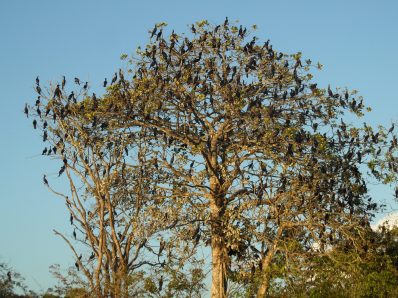
For those interested in the sorts of feathered friends I got to see, here’s a list of those I wrote down:
- ani, greater
- aracari
- black skimmer
- cacique, yellow-rumped
- caracara (type of falcon)
- cormorant
- egret, great
- duck, muscovy
- falcon, laughing
- hawk, black-collared
- hawk, roadside
- hawk, slate-colored
- heron, agami
- heron, rufescent tiger
- heron, capped
- heron, white
- heron, white-necked
- hoatzin (These are fantastic; the young have claws on their wings. This is worth a read.)
- jacana, wattled (among my favorites!)
- kingbird, tropical
- kingfisher
- kingfisher, Amazon
- limpkin
- macaw, chestnut-fronted
- nunbird, black-fronted
- owl—a big one 🙂
- panema (sp?)
- parakeet
- parrots, festive (always in pairs, among my favorites)
- parrots, short-tailed
- scarlet-crowned barbet
- swallow, blue and white
- swallow, white-winged
- tern, long-billed
- toucan, white-throated
- toucan, yellow-ridged
- trogon (don’t know what type)
- vulture, black
- vulture, turkey
- woodpecker, chestnut
- and countless others, including some I have photos of, but don’t match this list!
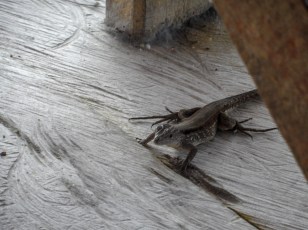
And a few more animals, of the non-feathered sort:
- fishing bat
- caiman
- tocoxi (gray) dolphin
- boto (pink) dolphin
- frogs
- lizards
- black-headed squirrel monkey
- capuchin monkey
- common squirrel monkey
- red howler monkey
- uacari monkey
- three-toed sloths
- butterflies
- red and black dragonflies
- tarantula
- And darn it, I missed seeing the bamboo and spiny tree rats!
 Learning the Language