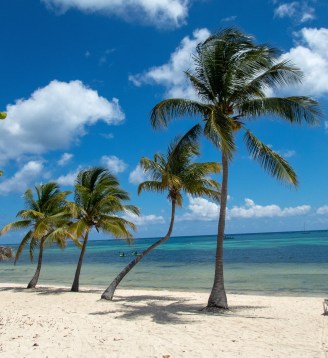
 In Little Cayman, the vibe above water is as mellow as it is below. And any day that I’m spending a few hours underwater and reading warnings of falling coconuts is a good one, right?
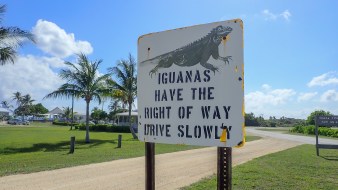
Our introduction to the Caribbean island and surrounding reefs of Little Cayman was pretty cool, with red-footed boobies flying overhead and rock iguanas roaming the Little Cayman Beach Resort, where we parked ourselves for a week. And of course, there was the saltwater and its amazing marine life that enticed us to make the journey: creatures ranging from nurse sharks, eagle rays, and soft corals to curious squid, hawksbill turtles, and Nassau grouper. And we even caught a glance of Prince Charles as he waved from the island’s new police helicopter after a day’s visit.
The Island
Little Cayman is the smallest of the three Cayman islands, roughly 150 miles south of Cuba and 170 miles west of Jamaica. The island is a narrow strip of only about 11 square miles, and it claims 40 feet at its highest elevation. The airstrip won’t handle a 737, so a 17-passenger twin-prop travels in and out a few times a day. There are around 170 residents on the island, and in my brief experience, they seemed pretty content.


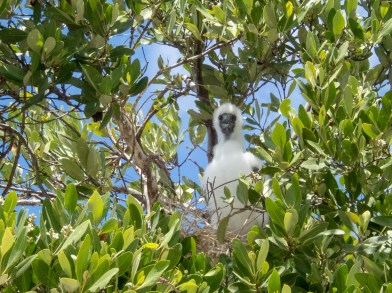
Among the delightful natural characteristics of Little Cayman is a protected pond called Booby Pond. As I was running one day, I heard squawking, and sure enough, there were baby red-footed boobies! High up in the trees, large, white, fluffy babies with black beaks swayed slightly in their nests, while the adults perched nearby with their red feet wrapped around branches. The island was also replete with frigates.
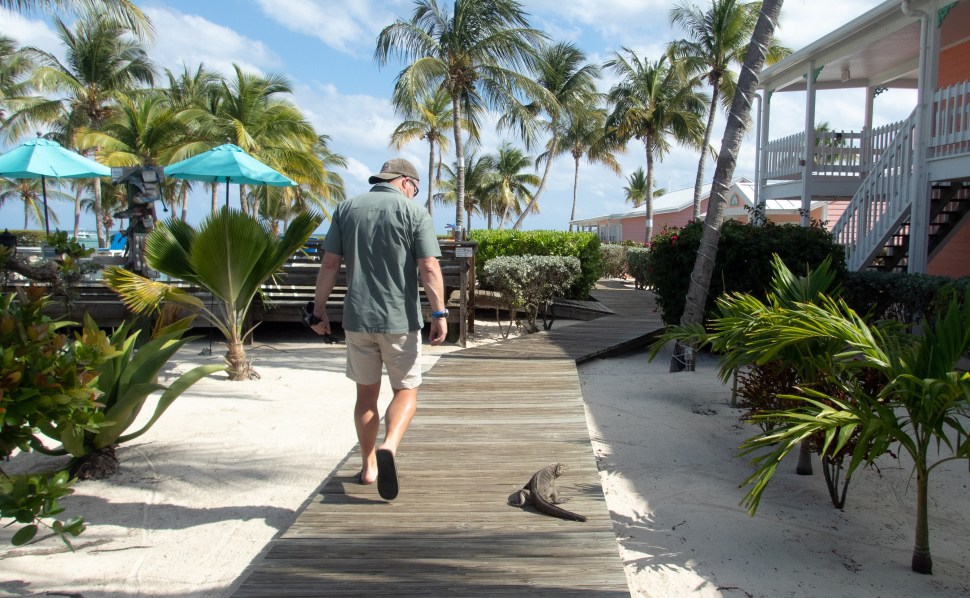
Rock iguanas are indigenous to Little Cayman, and throughout the day they lounge on the tile and boardwalks around the resort. Multiple times I saw vacationers almost walk right into the iguanas; the large lizards hide in plain sight, as they are usually motionless and blend into the boardwalk and its shadows.


Our last evening on the island we listened to an impassioned talk by a young German researcher, Tanja Laaser, who schooled us on the evil, invasive green iguanas who reproduce quickly and threaten the small population of native rock iguanas. I now own a “Green Iguana B’Gonna” T-shirt to support green iguana eradication. (Tanja folded the cash I gave her for the shirt into a wallet that she’d crafted from green iguana skin.)
On our last afternoon, we borrowed bikes from the resort to tour around the island a bit. We headed east, but soon we were passed by a small caravan of vehicles, and as soon as I saw it approaching, I knew what it was—Prince Charles’ motorcade! The Cayman Islands are a British territory, and Prince Charles was on the island for a short time that day. The vehicles were headed in the direction of the airstrip, so we whipped a 180 and followed them. (The motorcade was an awesome array of vehicles, including a pickup truck and a couple Suburbans, with the island’s emergency vehicle pulling up the rear.) Sure enough, we got to the airstrip in time to see the entourage board one of the little Twin Otter planes, and Prince Charles waved to the crowd of 20-30 people from the new police helicopter that shuttled him back to Grand Cayman.


The Resort
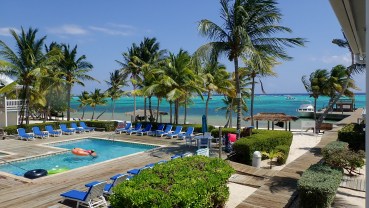
At the Little Cayman Beach Resort I was introduced to the term “valet” diving. (I like to imagine a silly comic where fish show up riding eagle rays, but it really meant that the dive staff went so far as to carry our scuba kits to us to don at the back of the boat.) It was my first experience in the all-inclusive realm, and we enjoyed it. The dive crew was both efficient and easy-going. Life both on and off the boat was just simple—not needing to schlep our gear around—and you could follow the dive guide or head out on your own. The food on land was solid, with meals signaled three times a day by a clanging bell. (Yes, we did feel slightly bovine.) But we also enjoyed getting to know our dive boat companions, whom we ended up hanging with both in the pool and at the bar.
We were among the younger folks at the resort. Retirees and empty nesters were the typical crowd. Almost everyone we hung with had been to the resort enough times that they weren’t counting, and while I don’t think we’d make it an annual trip, the relaxed, happy, community vibe of both the resort and the island as a whole may likely draw us in for a return.
The Diving
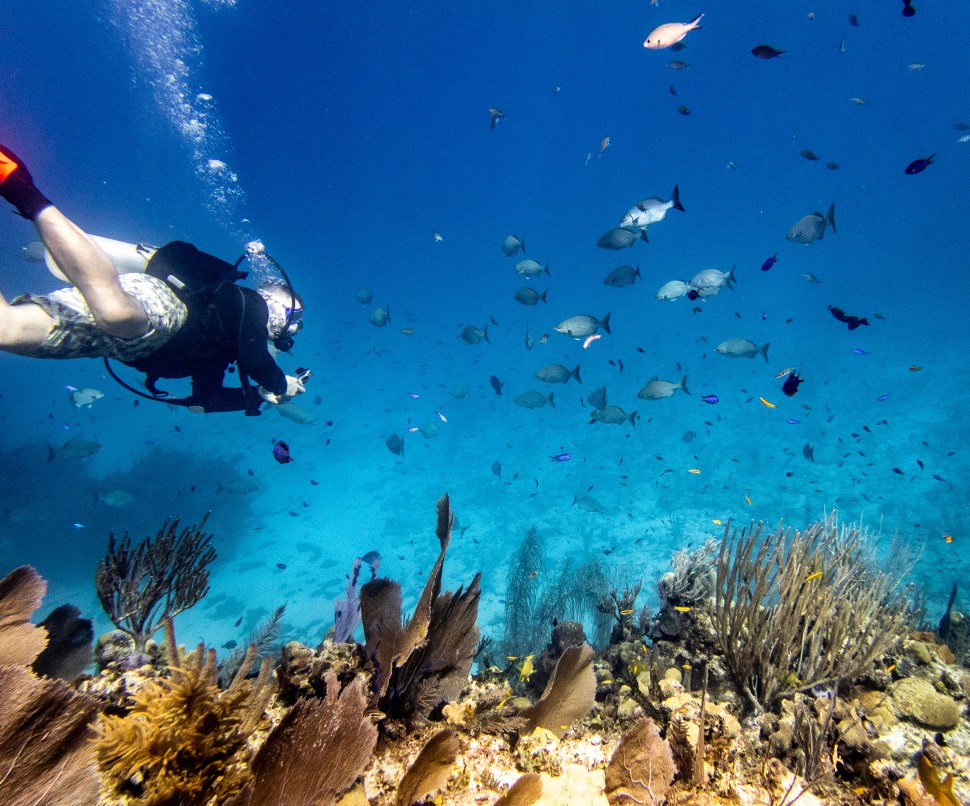
The charming but rather scrubby island is unindicative of the dramatic topography below the surface of the water. To the north is Bloody Bay Wall, the island’s signature diving area, which plummets to a depth that’s hard to pin down. (I’ve read that the depth is often exaggerated, and sure enough, the numbers vary significantly, from 3,000 to 6,000 feet.) The extreme drop-offs are actually much farther from shore than where the diving is. But it’s still notable that the Cayman Islands are little limestone pinnacles in the Caribbean. To the south, running mostly east to west between the Caymans and Jamaica, is the Cayman Trench. It’s the deepest point in the Caribbean, reaching deeper than 25,000 feet below sea level, and it marks the boundary between the North American and Caribbean tectonic plates.


Bloody Bay Wall is a marine park. (Though it took some tracking down, I’ve read a variety of explanations for the origin of the rather noteworthy title of the wall, most leaning toward the color of the water that resulted from the butchering of whales, but pirate battles are frequently credited as well.) The water temperature (in late March) was typically 81-82 degrees Fahrenheit, and the daytime air temp was also in the low- to mid-80s. There was no current to speak of, and it made for very easy diving (including some fun swim-throughs).


We were confined to the south side for some of our dives because winds were a bit too stiff on the less protected northern side, but most of those southern-side dives were solid as well, including some awesome coral fingers that rose 10-20 feet above a white-sand bottom.
There is little runoff from the island to mar visibility underwater, and though we didn’t get to experience the stunning visibility that Little Cayman is known for, it was still pretty cool.
The Creatures
Witnessing the journey of a conch for half a foot can take some tenacity. They’re shy, but they will poke an eye or two out far enough for a diver to see. You can then see a foot reach out, feel around, and then take a two-inch scoot. And then the shell is again still. On the sandy Little Cayman dives, I was fascinated by the number of conch shells, the highway of conch trails, and the distance those conch pathways stretched. If undisturbed by something like a stingray grazing over, how long do those trails endure, 40-60 feet down?
Stingrays were fairly common on our dives, as were nurse sharks. We saw a handful of hawksbill turtles, and I got to enjoy having one repeatedly circle me just a few feet away, dozens of feet above the seafloor. Eagle rays are around but a little more elusive. We did spot a few, including a couple from the boat. We saw a decent number of barracuda, and a few scorpionfish. Here and there we saw flamingo tongues, juvenile spotted drum fish, and barred hamlets.


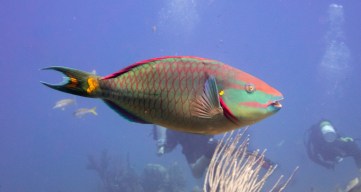
Since I became a diver, I’ve been interested in which creatures are sought after on a dive and which, by lack of mention, might be categorized more toward the mundane. Among those that aren’t often mentioned but are quite plentiful and remarkably cool and colorful are parrotfish.
Some interesting facts:
- At night, some parrotfish species coat themselves in a protective mucus cocoon that, among other possible benefits, scientists believe masks their scent to elude predators like sharks and moray eels while they snooze. (I’ve been told that if they are disturbed at night by divers with bright lights, it can disrupt the layer of mucus and thus leave them more vulnerable.)
-
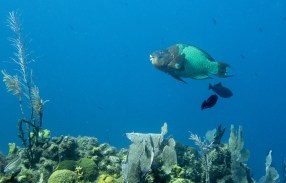
a rainbow parrotfish in the terminal phase (it’s hard to tell here, but this is a pretty big fish–they get up to five feet in length) They shape- and sex-shift. It’s complicated, but most species are sequential hermaphrodites, beginning as females and turning into males in a terminal phase.
- Their myriad (and changing) colors have made classification challenging, to say the least. Scientists have narrowed what were originally thought to be as many as 350 species to around 60.
- They poop sand. If you see a parrotfish, chances are it’s steadfastly munching away on algae and crunching on coral to get to it. Their incredibly strong front teeth are fused, creating a beak-like plate. “No biomineral in the world is stiffer than the tips of parrotfish teeth,” according to a March 2018 Smithsonian article. Molar-like teeth in their throats grind it down to white coral sand. A whole heck of a lot of sand: That same article notes that in one year, a large parrotfish can poop out 1,000 pounds of sand.
- They eat coral, but it’s okay. Most of what they eat is dead coral. What they are providing is essentially a cleaning service that makes coral reef ecosystems more resilient. Prominent marine biologist Ayana Elizabeth Johnson calls them “the most important fish on Caribbean coral reefs.” (In a Virgin blog post, she also suggests they have a garish fashion sense, which is hard to dispute.)
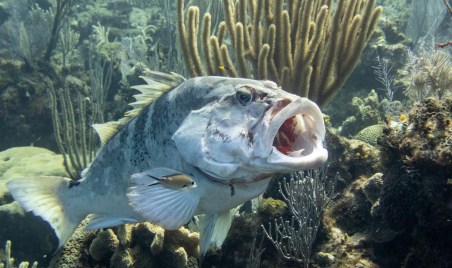
Among my favorite moments to see fish are when they’re getting serviced at a cleaning station. Grouper are common customers. Smaller creatures, like Pederson cleaner shrimp, set up shop cleaning larger fish—even rays, sharks, and eels—in a mutually beneficial relationship. These cleaner/client relationships are long-lasting. Grouper aren’t very shy, so it can be a bit easier to witness a cleaning station in action.
We saw dozens of Nassau grouper during our 18 dives off of Little Cayman, hovering, getting cleaned, and even wrestling once, which was pretty cool. Grouper (who also happen to be sequential hermaphrodites) can live up to a few decades. They are known among the science and diving community to be both intelligent and quite friendly. In What a Fish Knows,* Jonathan Balcombe describes the collaborative hunting alliances that groupers will engage in with partners such as big blue octopuses and giant moray eels. A grouper will find prey that it can’t access, find a moray eel, perform a headstand-shimmy of sorts, and then swim over to the location of the prey and “point” so the eel can locate the doomed creature. In total, the partners are able to catch more prey together than they can catch solo; the eels do better in narrow spots and crevices, while the groupers have more success in the open water.
Groupers are among the fish that will commonly approach familiar divers for a siderub, similar to a dog nudging up to a human for a scratch behind the ears. Balcombe writes, “You don’t have to have fur or feathers to have personality; scales and fins will suffice.”
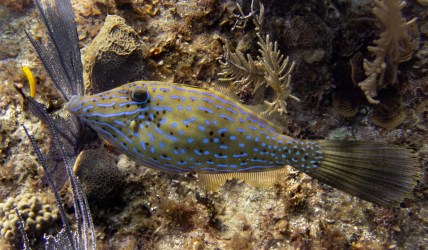
Among my underwater companions was a scrawled filefish, which was both quite pretty and affable. We spent a few minutes together, and I found multiple times that even as I’d swum away to stick with Jeff, I would find the little guy by my side. (I was even more gratified when I read later that they’re generally wary of divers.) It was grudgingly that I finally parted ways with my curious pal. Just like it’s hard to walk away from a dog who wants attention, I’m always bummed to part ways with an inquisitive sea creature.
Among the most beautiful aspects of diving of off Little Cayman was the vast number of gorgonians, or soft corals, like sea whips and sea fans. They are beautiful in their structure and color, but also in the way they undulate and catch sunlight. (And for an amateur photographer, their sessility, or lack of locomotion, make them accommodating subjects.) There was a beautiful pillar coral—I imagined it as a miniature sea castle—at Coconut Walk, and at Tibbets Top there were enormous barrel sponges spanning upwards of six feet.


At Richard’s Reef, Jeff spotted a mantis shrimp and later searched for it at length to show it to me, but to no avail. (Doggonit! I still haven’t seen one.)
Overall, I would say we didn’t see many creatures in high numbers like we often have at other dive locations, but there was still cool variety, particularly at Cumber’s Caves, my favorite of the week: We got to witness an eagle ray glide by, a couple of stingrays skating through and then sinking under a thin layer of sand, lots of skittish yellow-headed jawfish darting tail-first into their holes, barracuda lingering, neck crabs clinging to strands of coral, a reef shark who swam back and forth for quite some time (and actually stayed put even as we completed our safety stop and surfaced), lots of conchs doing that impressively sloooow conch thing, a queen triggerfish on a mission (as they always seem to be), and possibly the largest stretch of garden eels that I’ve seen to date, nodding their heads, looking a little muppet-like, and slipping into their holes in the white sand upon approach.


Night: Otherworldly underwater
Night is a special time in the sea. Lobsters venture out, crabs and shrimp emerge. Corals open up and dine. It is the best time to catch an octopus scampering about, and the squid are simply fabulous. Fish sleep under rocky overhangs, sometimes even lying on their sides.
After a three-dive day, Jeff and I ate an early dinner and set back out at dusk to see what nocturnal creatures we might find. We didn’t spot any octopuses, but we did get a good look at a couple of lobsters scurrying around. Brittle and basket stars appear pretty benign during the day, but holy cow! I watched a basket star, not super-clear what I was seeing, but it seemed to be eating voraciously–either that, or it might have just been curling up in my light. Both are quite possible (it is featured in a blog called Real Monstrosities, after all). My trusty Reef Creature Identification guide says of basket stars that they retreat and contract their arms into a fist-sized ball by day, climbing to the “top of elevated feeding perches at night to feed.” My video was not so hot for reasons shared below, but if you’re curious, here’s a cool video on Youtube.


I worry that what I’ll say next might give a diver pause before trying out a night dive, but here it is: The number of (harmless) bloodworms and other little creatures attracted to the dive light was overwhelming at times, and I frequently pressed the light against my wetsuit to darken the area around me and relieve myself of some of the bug-light mayhem. It got to the point where they were in my hair and hitting my face, and it was sometimes hard to see what I was shining my light on. Once back on the boat Jeff called me the “bloodworm queen”; though everyone was hit by them, we wondered if my light was particularly attractive. (I really want to believe it was my light and not me.) But Phil, one of the dive guides, had suggested that if we were fed up with the bloodworms we find brain corals, which eat the little wiggly suckers. I did seek out brain coral a few times to watch, fascinated, as the blood worms got trapped in. It couldn’t make an ounce of impact on the number of creatures in my light, but it did briefly alleviate the frustration with the bugs.

The proper name for a group of squid is “shoal,” though I found the trail of a group of enthusiastic petitioners (to a marine division at NOAA) calling the moniker a shame and appealing for a change to “squad.” So, though the petition seems to have failed (it had 80 supporters half a dozen years back), I’ll adopt their much more delightful term for this write-up. So… We came across a few squads of squid zipping this way and that in the mesh of dive lights. I watched Jeff get inked by a couple of small squid, with cute little dark puffs into the beam of his light. And toward the end of my dive I was joined by a lone (squadless), curious squid. We hovered together for a couple of minutes. I got some decent shots of it before reluctantly gliding away to stick with Jeff. (But Jeff’s pretty cute too.)
And with lights out, Jeff and I waved our hands vigorously through the water to stir it up and trigger some bioluminescence–lovely, ephemeral traces of blue.
—
I’ll leave the reader with some photos that didn’t make their way into the rest of the blog…


*What a Fish Knows is a recent favorite of mine, both quite enjoyable and incredibly informative.
Thanks to Dr. Alexander Mustard for some interesting and well-written information on Cayman marine life: https://oceanfrontiers.com/marine-life.html
 Learning the Language