Six Weeks of Sailing
July 27-30, Dominica: Portsmouth & Roseau
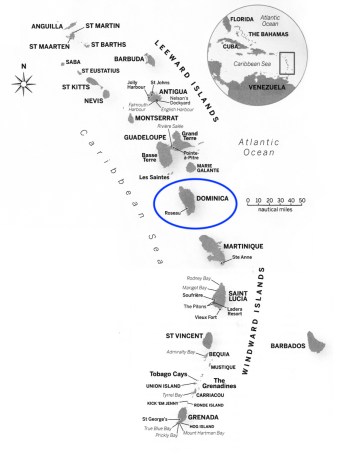 Over the course of our adventure we’d watched the moon wax and then wane, and it had waxed again to full as we returned to Dominica. Dominica held quite special memories from our previous visit, and it seemed fitting that we had come full circle to be back there for another full moon.


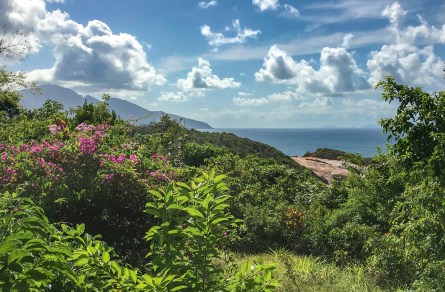
Dominica (Dom-min-NEEK-a) is mountainous and lush, with a rugged coastline. It is among the most beautiful places I’ve traveled to. And this, when so many Dominicans we met (including the customs agent) told us that it was a shame we hadn’t seen its beauty before category 5 Hurricane Maria tore through the previous September. The 290-square-mile island has nine active volcanoes, and it has rain forests, marshes, and coastal woodlands. Rivers and waterfalls are plentiful, as are volcanic vents. Dominica boasts a boiling lake second in size only to a boiling lake in New Zealand. (Our hike to the boiling lake during our last visit was possibly my favorite hike—ever.) Agriculture is still the backbone of the economy, primarily in banana crops, though the financial services industry is growing.
We arrived in Portsmouth and moored with the help of Alexis, who displayed the PAYS membership on his boat. (In Portsmouth, it’s recommended to only work with people associated with PAYS—it’s a nonprofit organization that provides security and services to boat cruisers.)


We then set off on a four-to-five hour excursion in Alexis’ van to the Pointe Baptiste chocolate factory in the northeastern area of the island. As with all of our tours, our afternoon was replete with information about his country, often focused on the flora and fauna: Dominica has opossums, agouti, and wild boars, he says, but if you see a monkey it’s plastic. Bay leaves are used for deodorant. People use smoke to rid their homes of boa constrictors, but he likes snakes. Alexis said something about chickens in suitcases following the hurricane, but tragically for this story, I couldn’t hear him well. (I’ve also read that the hefty mountain chicken frog, once part of a traditional dish, is now critically endangered.)


And frequently, the conversation turned toward the hurricane. You used to be able to stop on the road to pick mangoes off trees—Julie mangoes—they were so nice and so sweet, he said. And, “Before the hurricane, man, the coconut trees were so beautiful.” He was passionate as he talked about the hurricane-proof house that he had built himself. His children screamed in fear during the tempest, he said, but he was confident in his construction. And rightly so—it held up to the winds and rain and even the debris from his neighbors’ homes as they were shredded.
The chocolate tour with Maurina was interesting and tasty—we sampled bits of the fruit and cacao bean along its path to a chocolate bar, and we sampled a number of final-product flavors, from spicy to coffee. Ginger was my favorite.


The owner, Alan, gave us a tour of the grounds, lush with flowering bushes and trees, and rich with fruits and vegetables. We walked away with hands full of starfruit, breadfruit, papaya, and limes, adding to our (already dwindling) spoils of chocolate.


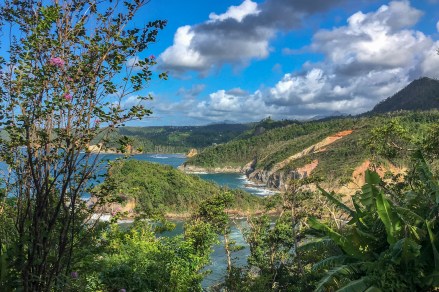 The coastal road that we traveled with Alexis was breathtaking, and a few times I was so overtaken with the beauty of the island that I came close to tears. The road wound high and low, in and out around the contours of the mountains, usually with a view of the hilly coastline. At times the sun cast a surreal light on the landscape. If I had been driving, I would have stopped at least a few dozen times. Most of the photos here are from the window of our moving car.


We drove through towns and saw piles of metal roofs, homes with no roofs or blue tarps, toilets standing with just three small walls, and countless bare trees at odd angles on hillsides. We heard about the banana trees, the coconut trees, the mango trees, almost all decimated.


We stopped to drink from a spring, where Alexis showed us some crayfish.


Without notice, Alexis drove us to the home where he’d grown up, and we stopped to meet his mother, who was shelling nuts for castor oil, his father, who was rolling up his sleeves and pant legs to wash himself while sitting on a low wall, and Alexis’ 10-year-old niece, who looked with her clothes and jewelry like she could have walked out of a home down the street from mine. Amy and I walked down the steep road a bit. A wrinkled elderly woman starting talking to us animatedly, but we couldn’t understand a word she said. Sometimes I couldn’t tell if she was excited or upset, and I wondered if she was telling us about the storm. We finally awkwardly walked away—it was apparent she could possibly talk at us for hours—but we all blew kisses to each other, and it felt okay. As we reached the car, another elderly woman wandered by wearing just one shoe. She hugged each of us and I got a kiss on the cheek as she smiled and wished us well. I watched as one of Alexis’ family members brought a large plate of food out to the yard to feed the animals. Skinny cats, dogs, and chickens all jockeyed for food, and one chicken in particular ran off with her winnings after each successful grab. On the road again, and when we returned to Portsmouth, Alexis took us by his current home to show us his three-week-old puppies, which he carried by the scruff of their necks.


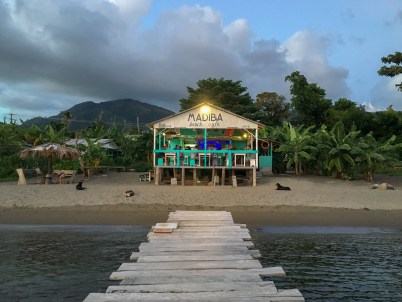 That night we had a last dinner with Jeff’s family at the Madiba beach cafe, the only joint open that we could get to from the beach, but it was very good food nonetheless. A man drew a picture of Albaran, our boat, for Jeff’s niece Kennedy.


Jeff’s family left the next morning, and we got the boat back in shape for our final crew arriving later that day: Cara, Mark, Mary, and Gary. We texted them asking if they could possibly pick up ice on their way from the airport, as everywhere Jeff and I tried, walking from the dock, ice was sold out or the machine was broken. The store we provisioned from that afternoon while we prepped for the crew’s arrival was tiny to begin with and had mostly empty shelves. We walked away with very little. But we did enjoy grilled plantains bought from a woman on the street (she said the Johnny cakes—fried dough—were too hot to eat), and we were able to buy limes and a few veggies at a stall (most produce is sold on the streets, not in stores).


Our crew’s arrival coincided with a full-moon party at Madiba. They had a DJ, and for the party they offered fish, chicken, salad, and goat water. Yes, goat water. We’d heard of it and cringed at the name, but the crew ordered a few bowls of it and it turned out to taste quite good—it was essentially a goat stew. The full-moon-party music that was promised to last until 4 a.m. fortunately didn’t carry too far on the water, and we all slept well.


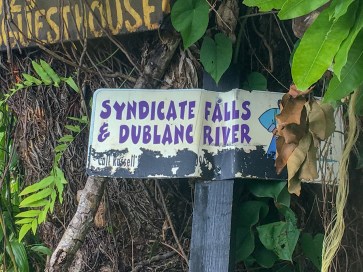 Before heading south for Roseau that Sunday afternoon, we opted to take a hike with Winston, one of Alexis’ comrades, to Syndicate Falls. I think it’s impossible to capture Winston on paper (or screen), but he is a 70-year-old animated fellow, yelling much of his communication and surprising us at every bend with which words would be loudest and longest and be honored with extra syllables. He sounded to me like a southern preacher, and I was tickled to learn that his best friend is a preacher. I would have paid good money to hear them “talk” with each other. (Over the next few days Mark randomly yelled “GUIDANCE! My brother!” echoing Winston’s periodic holler into his cell phone. When we later dived in Martinique, I was puzzled as I saw Mark take his regulator out of his mouth. Until he shouted “Guidance!”)


As we hiked, Winston chopped us bay leaves, cinnamon, thyme, mangoes, small red peppers, a switch off of a plant often used to snap at the backs of babies to make them walk (!!), and a fantastic pineapple with potential pineapple babies. We ate berries and sucked on ginger.


We crossed the small river a few times before getting to the waterfall. We stripped to our swimming suits and walked into the pool that was previously off-limits, as it had been a source of drinking water. Standing under the waterfall was tricky, as it was both blinding and literally breathtaking. But it also left us gasping with laughter.


We put shorts and shoes back on and turned back to the trail. Thanks to Winston’s strong arm and machete, we walked away with a giant stalk of sugarcane, and as we started our journey back to town he hopped out of the car a handful of times, running around to pick us a local bouquet.


Winston stopped for us to pick up a bit more ice, water, and beer, and while Jeff and I ran in, Mary and Cara spied a bakery across the street. That night we enjoyed both chocolate and carrot cakes in the cockpit.
Our sail that afternoon to Roseau was an easy 20-mile jaunt, and it was a beautiful, rolling first sail for our final crew. Our friend Beanz rode out to meet us in Sea Cat’s freshly painted boat, and Sea Cat drove us to the Fort Young Hotel for dinner. It was a Sunday during low season in a place still recovering from a hurricane, and the hotel’s restaurant was the only place open. But we weren’t complaining, as it was delicious. Many of us ate lionfish, the handsome but invasive creature.


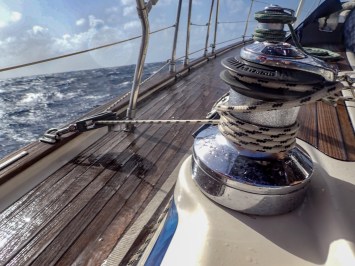 We set sail early Monday for Martinique. It turned out to be an adventurous passage, with winds clocking in at 40 knots, swells reaching 12 to 15 feet, and hours of saltwater spray that kept us soaked. It was an absolute blast.
 Learning the Language