Six Weeks of Sailing
July 23-27, Guadeloupe: Deshaies, Pigeon Island, and Terre-de-Haut


At 4:30 a.m., we set sail for Deshaies, Guadeloupe. Deshaies is another charming town, on the northwest coast of the French island. It was a long Monday, a 14-hour voyage from Nevis, and while it wasn’t our liveliest, it was unforgiving for those fighting mal de mar. (Five of eight of us were sick, and for a couple it was unrelenting—our poor seven-year-old sailor thought he was dying.) The “green room,” as Jeff put it, was the spot on the boat best for, well, losing one’s lunch overboard, and it was occupied the entire day. We sailed back past the small blocky “handsome rock” of Redonda, and back down the coast of Montserrat, staying outside of the Exclusion Zone shaped by its calamitous volcano.


Once more we got in a bit too late to get to customs, so we enjoyed the sunset and I cooked up an easy meal of pasta with marina sauce. Tuesday morning after Jeff checked us in, we took down our yellow quarantine flag, raised our French courtesy flag, and dinghied in to explore the small town. We stayed two nights, and in that time enjoyed guava-filled pastries, peeked through the gates to the hillside cemetery, and watched sea turtles bob up near our boat for a few gulps of air.


Guadeloupe is among the few islands we visited where we could dive on our own (most require you to dive with a local company), and Jeff and I jumped off the boat for a lovely mid-day dive off the northern point of the bay while others snorkeled. We got to see some beautifully colored coral, a number of eels, an enormous balloon fish, a huge spotted drum fish, and a rust-colored, bassinet-shaped sponge holding beautiful purple coral and feather dusters.


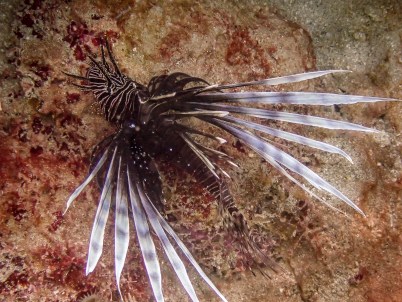
I found a few patches of purple eggs, each guarded by a male black-and-white-striped sergeant major—the males develop a hint of blue when mating and guarding eggs. They will strike at other fish coming near the patch and sometimes at a diver’s camera. There has been no shortage of flamingo tongues in this part of the world, and I can’t help but turn on my camera every time I see one. We saw a few lionfish, but Jeff hadn’t brought his Hawaiian sling to spear them; they are beautiful, but they are invasive in the Caribbean, gobbling up fish but falling prey to no one but humans.


I always enjoy seeing a fish, like the grouper below, at a “cleaning station.” Many sea creatures, like Pederson cleaner shrimp (which grow no more than an inch in length), make their livings in a mutually beneficial relationship cleaning larger fish, including rays, sharks, and eels. Researchers have noted that these cleaner fish/client relationships are long-lasting; clients prefer to return to a familiar station over one that is most convenient.*


Wednesday arrived and we sailed two hours south for a quick stop to dive the Jacques Cousteau Reserve–the man himself declared it among the world’s top diving areas. We anchored near Plage de Malendure, and Jeff, Amy, and I caught a ride with a dive boat over to Pigeon Island and the reserve.


We had great visibility and just lots of awesome, beautiful fish. We got a close-up with a turtle, a large death-looking crab, and a snake eel slithering about. The barrel sponges were sizable. With the great light and vis as well as so much marine life, it felt like we were gliding through an aquarium.


And then another short sail back down to the island of Terre-de-Haut, one of the eight Les Saintes islands, where we’d been a few weeks before. We again hung out in Bourg des Saintes, where among other things, we ate gelato. (I was particularly fond of the pistachio.)


We also returned to Pain de Sucre, where we snorkeled and dived. I saw the smallest eel I’ve ever seen. The light was a bit low, and so we got to see lots of crabs and shrimp.


I was particularly enamored (129 photos and videos worth) with three Caribbean reef squid who were curious and friendly—one was particularly sociable, and one was more reserved, usually behind the others or out of sight.* We spent almost eight minutes watching each other (as gauged by the timestamp on my plethora of photos). I’ll spare the reader 121 of them.


I also had a successful photo shoot with a super-cool spotted cleaner shrimp, with some corkscrew anemone in the background. (This little shrimp would have been no more than one inch in length.)


On the French islands there seemed to be more nudity on the nearby boats. When you’re moored or anchored, a primary form of entertainment is watching what’s going on on other boats—Who’s coming in? Who’s leaving? That crew is struggling to grab the mooring ball. They have a dog. I wonder if they know their dinghy is leaking. And, oh, that old guy’s naked. (I hope you weren’t imagining a topless young nymph.)
From Les Saintes we sailed to Dominica, where we’d been a full moon before.
*In recent months I’ve quite enjoyed a few books on marine life, and one of them is What a Fish Knows, by Jonathan Balcombe. He cites much evidence of awareness, cooperation, and planning on the part of our “underwater cousins” as he calls them. And while we as humans certainly anthropomorphize animals we interact with, there’s also no doubt that they—including our squid companions that lovely afternoon—have a range of temperaments and personalities. I also learned more about the cleaner-client relationship through Balcombe’s book.
 Learning the Language