Six Weeks of Sailing
July 12-15, Saba
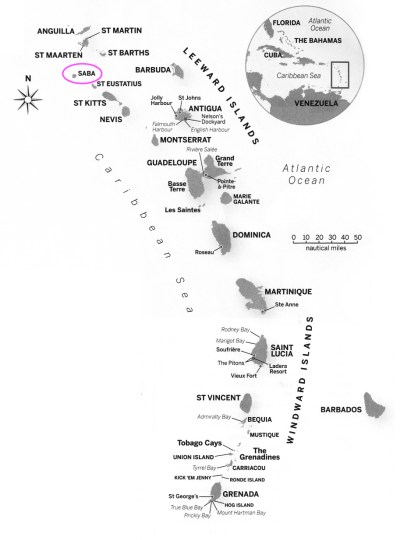
On Thursday, July 12, Jeff, Ed, and I set sail from Basseterre, St. Kitts, to Saba (“Say-ba”), an island that had become almost legendary for us, thanks largely to sailing vlogs and YouTube diving videos. It’s a lush, five-square-mile, Dutch island, steep all around, and in fact it’s the tallest mountain, at 3,084 feet, that is part of the Netherlands. The former customs house is halfway up a cliff, and many years ago, for boats that were able to anchor (and they sometimes had to wait days for conditions calm enough to anchor and disembark), visitors then had to climb some 800 steps, passing the customs house, to reach the town, which is delightfully called The Bottom. (I believe it was even harder than getting through that last sentence.) Back in the day when that was the only way to the top, everything that got to the top had to be carried, including (according to legend) a piano, the queen, and a bishop.
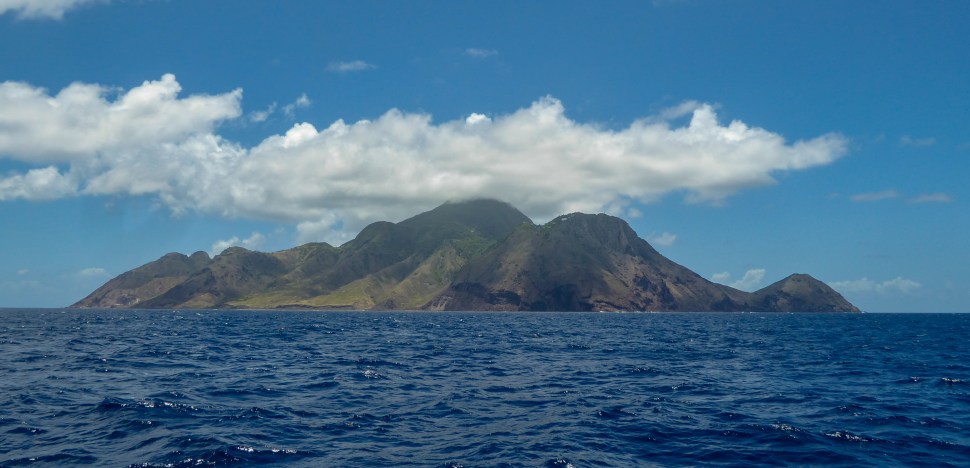
The people of Saba are described as resilient and friendly, and Chris Doyle, in his cruising guide, says, “They are unimpressed by obstacles.” When outside engineers were consulted and they reported that a road from the sea couldn’t be built, local Joseph Hassel took a correspondence course in road building and the hardy folk built it themselves. It is referred to as “The Road that Couldn’t Be Built,” and taxi drivers are said to call it “The Road that Shouldn’t Have Been Built.” You can probably guess what happened when the people of Saba were similarly told that an airport couldn’t be built. It is the shortest commercial runway in the world. Houses sit precipitously on the cliffs.
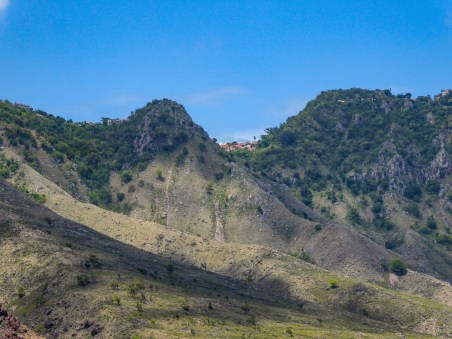
Saba has an international med school, whose students add 30-50% to the population, and sand and gravel is mined. The island was safe from Columbus, who passed it by thanks to its treacherous cliffs (shall we call them “obstacles”?). The first non-natives were a group of shipwrecked Englishmen, but the island changed hands among the Dutch, English, French, and Spanish. And as with the rest of the Caribbean, African slaves did much of the work on the island. Saba was for years a haven for pirates (at one point in earlier history British pirate Henry Morgan chased away the Dutch), and later, when men took on trades as sailors and fishermen and were thus gone for long stretches, the island was nicknamed “The Island of Women.”
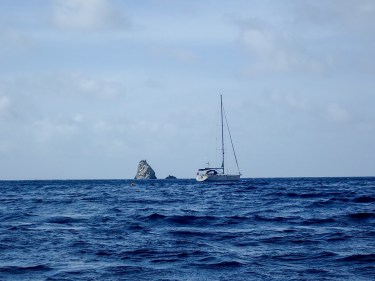
Our 36-mile, seven-hour sail to Saba was not, as Jeff put it, “for the faint of heart.” Though the voyage wasn’t unsafe, it was rough. (Saba is off-limits if you charter a boat through some companies, but I believe that’s because of the rough moorings—anchoring would be foolhardy.) Along the way we passed the island of St. Eustatius (“Statia”), another Dutch island that is a bit more industrial.


As we approached the tall island, a white butterfly showed up and flittered beside our boat. We were surprised at how far out the small creature was from land, but it flitted near us for at least 25 minutes. It would swing close to the boat and then back out, often just inches above the waves; it seemed that there was a small cushion of air keeping it from hitting the water. I was nervously coaching it along, possibly underestimating the powers of butterflies, but I think as a Saban butterfly it was perhaps unimpressed by obstacles.
It was rough getting a temporary mooring ball, not too bad getting the dinghy into the water (for long sails we pull it out and tie it to the foredeck), but rough again getting the motor into the dinghy. Ed and I crossed our fingers as Jeff headed across the rough waters to the new customs station in Fort Bay. Though conditions were slightly better when we motored around the southwest corner to Ladder Bay to pick up a ball to moor for the next few nights, mooring there was also a struggle. We got pulled away from the ball we were attempting to tie to, and the boat hook pulled from my hand and dropped into the water. It was a daring rescue as Ed climbed into the dinghy being pulled by the boat to grab it.


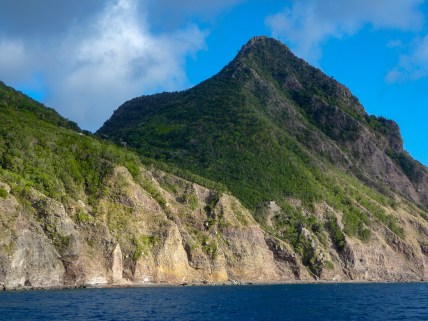
But once we were “settled” (I hesitate to use that word because of the wind and waves, but we were perfectly content), we enjoyed a beautiful view, which included the old customs house. Ed spotted white goats and then black goats grazing on the face of the cliff, and the evening sun cast a lovely glow on the island. The stunning sky led to a striking sunset—our best to date. As it got later, I cooked up mac and cheese with a side of canned legumes (the easy boat meal), and we stargazed. Jeff jokingly complained that the abundance of stars made it hard to see the constellations, but it was true. What a lovely problem to have.


At night it was dark enough that we could see bioluminescence glimmering as waves stirred up the water by the boat. (It was also fun to keep the lights off in the heads at night as we pumped salt water through the toilets—the bluish, indistinct, ethereal bits of light flickered when agitated in there too.)

Friday morning we made the wet, 25-minute dinghy ride back to Fort Bay, where we met up with the Sea Saba dive boat for two morning dives. We dived with Rob, Steven, and Maryanne from Sea Saba, and they are a first-class crew. They were safety conscious and laid back, and they let us continue to dive as long as we had air. They were prompt but not militaristic, and they were as excited to see cool marine life as we were, always asking us to point creatures out to them. Highly, highly recommended.
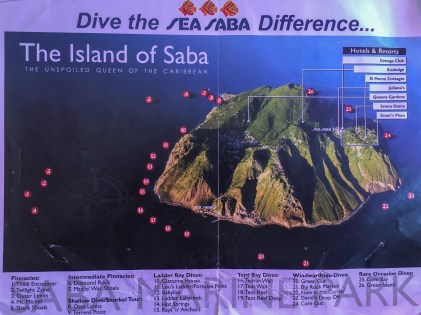
We got three dives in with the Sea Saba crew on Saturday. Conditions were too rough either day for us to dive any of the famous pinnacles, but the diving was still pretty cool. Dives there are all deep—the most shallow of our five dives maxed at 73 feet. Highlights included a few nurse sharks, Caribbean reef sharks, a few turtles, a pygmy filefish, and though they’ve been common everywhere, I love the Pederson cleaner shrimp. And my favorites: a little white octopus, smaller than the size of my hand, that was shimmying his way along the top of a wall, and three black-and-white or black-and-yellow juvenile trunk fish—they are basically a black ball the size of a pea, with white or yellow spots. You can barely make out a face or fins, it just looks like a tiny ball hovering the way a pingpong ball gently bounces on an upward blast of air. Really, really awesome. For the sake of not breaking up the page any more, I’ve stuck the dive photos at the bottom.
Saba’s two towns, The Bottom and Windwardside, have narrow roads and whitewashed houses with red roofs. After diving each day we caught a ride up to Windwardside with fellow divers, one a man from Atlanta, and the other a young Dutch customs agent who kindly also drove us back down to the dock at Fort Bay. (One day we walked down, but I was thankful I’d had that ride up!) The roads are narrow, steep, windy, and sometimes hugging the contours of the island on the eastern, not-a-straight-cliff side—the views are extraordinary. The school sits on a high promontory, and as an elementary school teacher I briefly wondered how they train young kids to stay away from the cliffs that border it on three sides.


We ate one afternoon at the Busy B Bakery and Café, where the multigrain bread they used for my egg salad sandwich was perfection. If you happen to be in Saba and are into such things, grab a bottle of Saba Spice rum!


Our nights in Saba were rough. The winds howled (we know they got to at least 30 mph during the day, but we didn’t have the instruments on at night), the waves got bigger, and lying in bed in a cabin, even Jeff as an experienced sailor got no rest. We each popped up numerous times to make sure we were still where we were supposed to be, that our boat was still intact, that the dinghy hadn’t escaped, and that other boats were also where they were supposed to be and hadn’t sprung away from their own mooring balls to careen toward us and make all the aforementioned concerns our ghastly reality. The third night we strapped the dinghy to the foredeck in preparation for our long sail the following day, but sometime in the night Jeff and I (because of course we were both awake) saw it lift up with the wind. Jeff sprung up off our bed through the hatch, with me right behind him, and we secured it with an additional line. (One night was particularly rough for a squid who somehow fatally ended up on our deck.)


 And so on Sunday, July 15, after three sleepless nights and four very long and drenching dinghy rides, we said goodbye to Saba what felt like much too soon. We have unfinished business there, with pinnacles to explore, stairs to climb, and cool towns to stroll through. Jeff wants to challenge the industrious residents to build the marina that couldn’t be built. Unless that happens (and it probably won’t, as it would damage reefs), we expect to return by plane and ferry rather than by sailboat for a land-based, more restful trip. But while you won’t see us spending a hunk of time on the surface of the water, you will often find us exploring pinnacles 80 feet below.
Dive Photos, by Dive Site
Babylon


Tent Reef


Below, look first at the photo on the left to see if you can spot the octopus (zoomed and highlighted at right).


Customs House
You can see the scale of the Pederson cleaner shrimp against Jeff’s hand.


Poriotes Point


Tent Boulders
The top few are a montage of the juvenile trunkfish, so tiny in their surroundings!


 Learning the Language