Six Weeks of Sailing
July 6-12, Charlestown, Nevis & Basseterre, St. Kitts
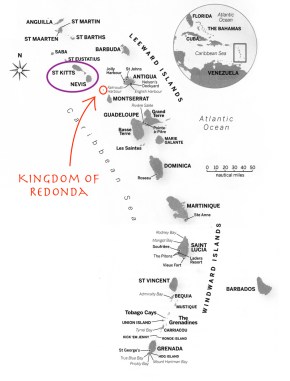 Our Friday sail to Charlestown, Nevis, from Montserrat went quickly, taking 5.5 hours. We passed Redonda on the way, and we were mesmerized by hordes of boobies and frigates near the small, steep, blocky island. There were some odd winds they rode, gliding in large spirals and then diving for fish.


It is one mile long by one-third of a mile wide, and it reaches 971 feet in height. It is generally uninhabitable, though a handful of conservationists have camped out to help restore the vegetation (eaten by goats introduced around 300 years ago) that used to support the island’s diverse fauna, including reptiles and tropical birds. The goats have started to die out themselves, because they’ve eaten that lovely carpet of plants. So the 75 or so voracious herbivores that were left were flown out last year by helicopter, with shower caps or yoga-pant-turned-hoods over their heads to keep them calm and swimming noodles on their horns to protect them from each other. (I very much enjoyed the BBC headline: “Why flying goats in yoga pants could save a Caribbean island.”) The island’s invasive black rats have also been on the list to boot from the island. They arrived on the island when the island was mined for—wait for it—guano. Many thousands of tons of phosphates were shipped off to Britain.
The entertaining history continues. Redonda is officially “The Kingdom of Redonda,” and on Wikipedia it’s described as a micronation and an absolute monarchy. Chris Doyle, in his cruising guide, describes the story of a man who finally had a son after eight daughters. So as any father would, he wanted a kingdom for his son. He claimed the island, and he took the Bishop of Antigua for a day trip to crown the boy King Filipe I of Redonda. There are varying accounts of the story, but it seems that a number of people have claimed to be the legitimate “king” of Redonda. We’ve heard there’s good diving, but it’s a process to get there and anchor a boat. Even if the diving was mediocre, Jeff and I would have loved to mark a place called The Kingdom of Redonda in our dive logs. Doyle describes Redonda as “a handsome rock.”
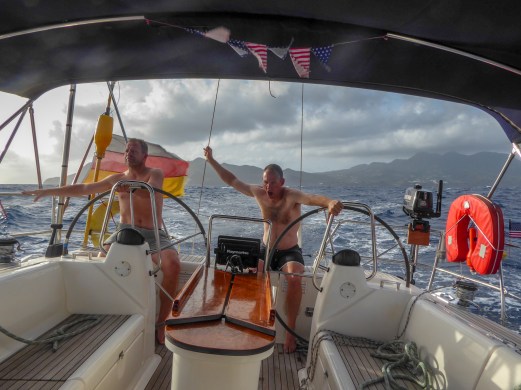
The funny island had funny winds combined with funny currents that took us a bit by surprise—we were pretty close to the handsome rock—and we ended up rounding up and doing a couple half-donuts before we were able to fully pass. Fortunately, by then everyone on board understood that the boat can’t tip over—if it gets as far as laid almost flat on its side, the air spills from the sails, and the sails can no longer pull the boat over. The keel weighs more than 7,000 pounds.


We got into Nevis just before noon, but it was almost three hours before Jeff was able to clear us at customs. (What we generally refer to as “island time,” in this case was an unscheduled break at customs, probably to watch the soccer game that Jeff and Scott were both hoping to see). We then found a good mooring ball in front of a beach with restaurants, and we progressed from tasty appetizers at Turtle Time to dinner at Sunshine, a restaurant “famous” for its “killer bee” drinks. (Sunshine himself waved us in; someone nearby said, “If Sunshine invites you in, you have to come!”) Every restaurant has its signature rum-based drink.
Nevis was a quick, one-night stop, due to the incoming storm that at that point was still a hurricane out at sea. Nevis is a round island with no bays, and we needed to find a place to hunker down in case strong winds came through—they were predicted to be gale-force. Before leaving Nevis we needed to refill the water tanks and fill up on diesel. Though the fuel guy had told us to head on over to the fuel dock, we waited close to three hours for the truck to show up (but when it arrived he just drove Scott and Jeff to the gas station to fill up with large jerry cans).
But the wait for diesel worked out well, as we were docked near a bar where Scott and Jeff were able to catch a World Cup soccer game, and Lisa, Ann, and Kim walked and returned with a number of pastries from the Nevis Bakery—the guava-filled were particularly delectable. I hung out at the bar and took advantage of an outlet and wifi.


 I’d worked on arranging a slip for us in St. Kitts (Nevis’ sister island—they are one country), and we couldn’t get into our first choice, Christophe Harbour, because they don’t carry hurricane insurance. But I was able to get us into the Port Zante Marina (which the official charts refer to as a “deathtrap” during hurricanes) in the capital, Basseterre. We would be staying in the peaceful deathtrap—getting the best sleep we’d had to date—for five nights, saying goodbye to our current crew and picking up Ed.
Here’s a link to a video of our crew, thinking we were taking a photo with a timer, through Lisa’s camera.
Our first task when we arrived in the marina on Saturday was to ready the boat for the approaching storm. We dropped Ann off to grab a taxi to the airport and then headed for our berth. Getting the boat into the slip was challenging, as the winds were high and gusty, and the bow thruster (which pushes the front of the boat laterally) wasn’t functioning. We used every line we had to attach to pilings and the dock so that the boat couldn’t move forward, back, or side to side. We took down the bimini and the dodger (covers for the cockpit), but we didn’t take the headsail or the boom down—things we would have done if the storm was still predicted to be ferocious.

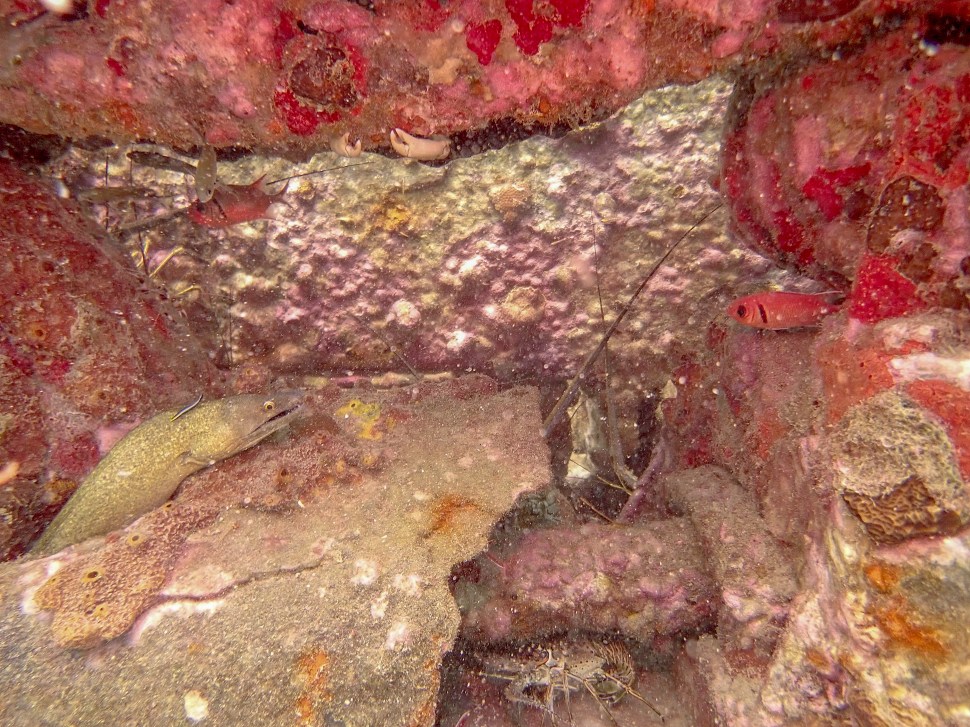
Kim, Scott, Jeff, and I had a morning to dive. The diving conditions weren’t great, and we couldn’t go to the better sites, but a small wreck broken in half by a hurricane at a site called River Taw in Basseterre Bay was mesmerizing. It was teeming with life, with cool creatures but also just thousands of fish moving in unison in schools, in and around the beautiful artificial reef of the wreck (vessels are often intentionally sunk because reefs grow on them, hence the term “artificial reef”). We saw an octopus surrounded by the evidence of its dinner—empty clam shells. We saw lots of bristled fire worms, iridescent jackfish that hover vertically above their holes in the sand, a moray eel, and a fantastic crab—my best guess is a nodose rubble crab. I’ve been loving the many little googly-eyed blennies that we see sticking out of coral heads.


We still had an afternoon to hang out with Lisa, whose flight was delayed due to the approaching storm. We grabbed a taxi to head south over the narrow stretch of land where you can see both the Atlantic and Caribbean oceans from the high coastal road, and we landed for the afternoon at Shipwreck, a popular Caribbean beach restaurant with buckets of beer and delicious vegetarian soft tacos. Green monkeys come out daily to eat the peanuts that restaurant staff leave for them. We even glimpsed a mama monkey holding her young one. Lisa stayed a night at the Marriott–we hung out in the hotel pool in the evening as we watched the palm trees blow with the increasing winds.


The Heavy Rains Formerly Known as Hurricane Beryl hit early Monday morning, and the winds had died down enough that, being tied down tight in a marina, we had the best night’s sleep we’d had yet on the boat. But we continued to joke about braving the “deathtrap” the marina was claimed to be.
After the rain died down we took the local bus (careening through school zones at 70 mph) to a forest road leading to the Brimstone Hill Fortress, whose first cannons were mounted in 1690. Along the way we spied monkeys, checked out an enormous lime kiln, and enjoyed seeing three cats hanging out near a “No Dogs Allowed” sign. Here and there we also spotted a mongoose dashing across the road and into the trees.


The fortress, now a UNESCO World Heritage Site, was designed by the British but built by African slaves. In 1782 the French attacked, 8,000 strong, and the 1,000 troops defending the fortress surrendered after a month of battling. In 1794 the island was returned to the British, and in 1983 St. Christopher (St. Kitts) and Nevis became an independent country. The impressive fortress covers the hilltop and creeps down its sides. It’s complete with barracks, officers’ quarters, a citadel, and bastions, but also with water catchment systems, a cemetery, and countless cannons.


We hopped in another bus, which dropped us in St. Paul’s at a road that leads to the Kittitian Hill. Kittitian Hill is a “visionary” boutique, top-of-the-hill (and top of the socioeconomic ladder) sustainable resort, and we got drenched with rain as we walked. A kind man who works for the resort stopped to check on our well-being, welcomed us into his spotless (dry) silver car and drove us the rest of the way. We were given a tour of the grounds and the bar and restaurant, which were beautifully decorated with old trunks, phonographs, and other antiques. I felt a little sheepish being there in our drenched garb after a day of hiking, but the staff (and there were many) were very gracious and welcoming. We never figured out how much it cost to stay as a guest or buy one of their villas, but it was among the most elegant places I’ve been.


After Scott and Kim departed on Tuesday, we took a couple of easy days taking care of provisions and laundry, watching World Cup games, and people-watching cruise-shippers. St. Kitts can handle two cruise ships, and the area by the port was a ghost town most of the days we were in town and bustling on that last day when two cruise ships came into port. Just outside that tourist zone, the town was authentic; my guess is most tourists don’t roam outside the restaurant and shop zone, which is even loosely roped off (I think to keep the tourists in). If they do roam, there’s an enormous overhead sign reading “Back to Ship.” (Included below is a photo from the Chinese grocery store, which had bikes on top of the meat coolers. Yoga mats were with the bread, I could go on and on.)


Ed arrived on Wednesday in time to catch the end of the Croatia vs. England match, with a lively crowd of locals and, to our surprise, a whole pack of Croatians sitting behind us. They were rowdy, Croatia won, and they left behind piles of cigarette butts.


We returned to Boozie’s, a dinner spot we’d enjoyed our first night in town, and one of our young waiters introduced himself as the local slam-dunk champion, three years straight. He told me to hold up my hand and he put his palm up to mine. Later, he told me to stand up—I’m 5’3”, he’s 6’7” and has “a seven-foot wingspan.” His smile is proportional. His name is Jay; he pulled up Facebook, and we’re now “friends.”


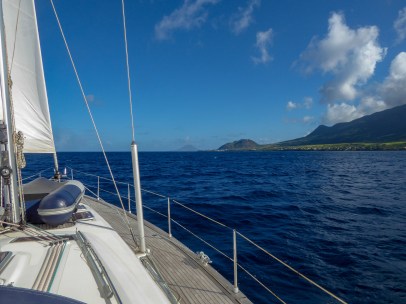
The next morning we set off for 10 days as our new three-person crew. Our first adventure was Saba, which was the farthest point in our journey and a gem we’d been anticipating for months. And with Ed on board, Jeff broke out Iron Maiden.
 Learning the Language
2 comments