Six Weeks of Sailing
July 4-6, Montserrat
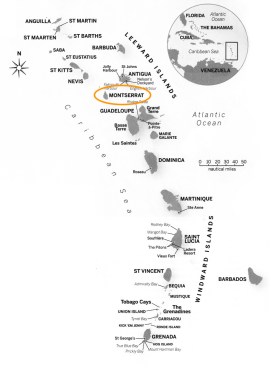 On the Fourth of July, Jeff, Scott, and I got up early. We raised our American flag, stuck smaller flags on the stanchions, and strung a banner across the bimini (the awning over the cockpit). We left at 6:30 a.m. to sail north toward Montserrat. Scott and I had a push-up challenge going—not something to work on in lively seas!


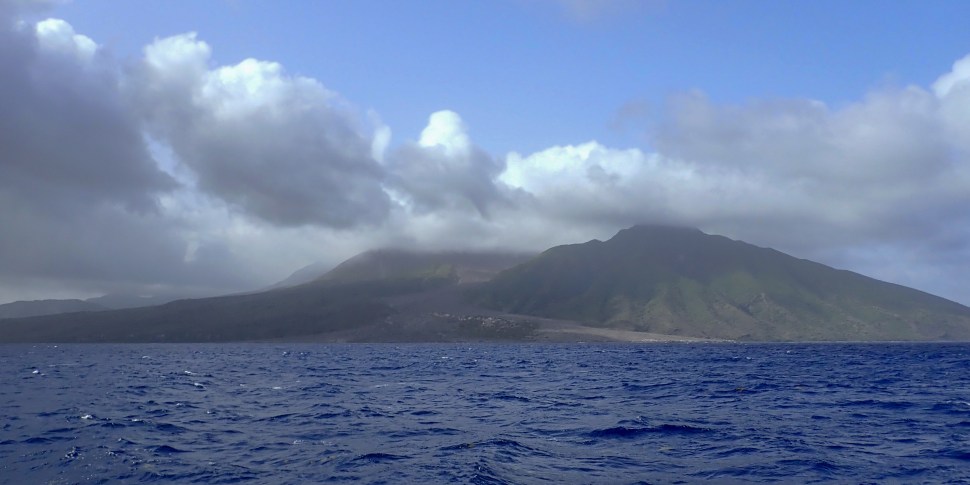
Montserrat loomed larger than we’d expected when we could finally see it through the haze of the day. It’s a beautiful experience to slowly approach land—you can see it for hours before you can reach it—but Montserrat’s recent volcanic history made us watch more intently, using binoculars and consulting guidebooks as we started to make out ruins. Ash flows off the island in the same patterns that glaciers flow off icefields. We remarked and pointed as we could start to make out homes that were partially covered, the lack of roads, and the lush greenery in stark contrast to the desolation left by the paths of the volcano.
There is an Exclusion Zone that makes up the southern half of the island, an area still at risk. The zone extends into the sea, as the lava and ash have extended the land by a square kilometer and raised the level of the seabed off the coastline—we had to give the southern section of the island a wide berth.


Many of the islands we visited were named by Columbus, after, of course, they already had names from natives. The Arawak name for the island is Alliouagana, which means “Land of the Prickly Bush,” and Columbus dubbed it Monserrado after a mountain near Barcelona. (My family also has a name for the island: “Monster Rat”—it was among my Uncle Marty’s favorite places many years ago.) Montserrat is a British island, though there’s a strong Irish influence. (Irish Catholics became part of the first European colony when they were moved to Montserrat in 1631 so that they wouldn’t oppose English Protestants on St. Kitts; Irish political prisoners were also transferred to the island).
Our 65-mile passage took 12 hours, longer than we expected, as the winds were inconsistent. But we only motored for a short time mid-journey, when being in the lee of Guadeloupe really seemed to cut our wind. It was also our first anchor, as Montserrat only has a few mooring balls and all are reserved for fishing vessels. The sun sets early in the Caribbean, and light was waning as we anchored.
Anchoring, you typically let out about seven times as much chain and line as the height from deck (where the anchor leaves the boat) to the ocean floor; this allows for plenty of give as the boat rolls up and down with surge and waves, and it pulls the anchor horizontally rather than vertically, which can dislodge it. The heavier the conditions, the higher the ratio you want, but you also have to take into account how far the boat might swing.
 After you’ve let out the chain you think you need, you put the boat in reverse, using the motor to set the anchor and pull against it to test its grip. After that, we like to snorkel the anchor to check it. In Montserrat, Scott and I jumped in the water, which was darkening and about 25-30 feet deep, and with our dive lights tried to keep track of where the anchor was setting and whether it dragged as Jeff reversed. We were set well (and I was very glad to have Scott in the water with me–it was a bit creepy!). Dragging anchor in the middle of the night can be a disaster, so we also set alarms periodically to pop our heads out of the hatch to check that we haven’t moved. There’s also an app called “Drag Queen” that Jeff uses. That first night in Montserrat, because we weren’t cleared through customs yet, dinner was on the boat (a delicious Mexican concoction thanks to Kim, Lisa, and Ann!).
After Jeff cleared us in Montserrat the next morning, we dinghied to the industrial-looking Montserrat port. We were quickly approached by a guide who introduced himself as Joe Phillip and handed us a brochure, explaining that he’s listed in the yachting cruising guide.
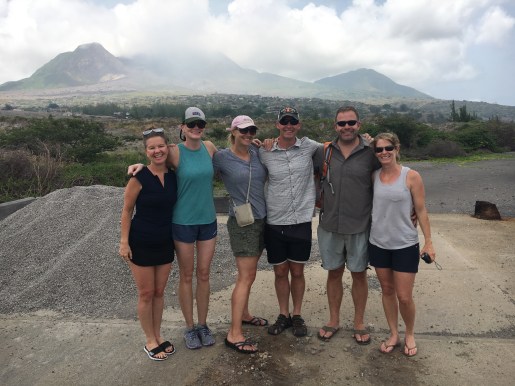
The six of us hopped into Joe’s van for a four-hour tour, primarily of the destruction left by the Soufriere Hills Volcano over a number of years. In 1995 the volcano ended a 400-year hibernation, beginning by shooting roaring steam thousands of feet high for more than a month. It was followed by a large volcanic eruption and a pyroclastic flow that led to the evacuation of the capital, Plymouth. (Pyroclastic flows occur during explosive eruptions or when pieces of a volcanic dome fracture and cascade down the slopes. They are a mix of rock and gas that can move more than 400 miles per hour and carry temperatures of more than 1800 degrees Fahrenheit.)
Joe explained that his village, Cork Hill, was evacuated on June 25, 1997. He was told the evacuation would last the weekend, but he and his wife and child occupied a room in a school for what turned into two years and three months. At that point his village was now in a building, he said, and Cork Hill was on its way to becoming a jungle. Today, referring to the weekend evacuation that began in 1997, Joe says “the weekend hasn’t ended.”
With many homes, jobs, and schools lost, 8,000 of the island’s 11,000 residents moved away. Today the population is back up to 5,000, not because people moved back home, but because people moved to Montserrat from neighboring islands. He told his wife that he wouldn’t force her to stay on Montserrat, and he wouldn’t follow her if she left. She stayed. Joe has been a tour guide on the island as long as I’ve been alive, and his tours changed dramatically since Soufriere woke up in the ’90s.
On the day Joe was evacuated, a day he titles “Woeful Wednesday” in his brochure, 19 people were killed as pyroclastic flows moved through villages.
The volcanic activity continued, and over 30 days in the fall of 1997, a period Joe refers to in his brochure as “30-Day-Mayhem,” 76 highly explosive eruptions occurred, producing ash clouds that climbed higher than eight miles. Volcanic activity has continued since, most recently in 2011, with mud flowing down the northwestern slope.
As Joe drove us through the steep, somewhat lush hills to the Exclusion Zone, he pointed to houses and other buildings that had become overgrown after being abandoned and covered with ash. He would point out the window and make comments like “There’s a school down there, somewhere in those trees.”
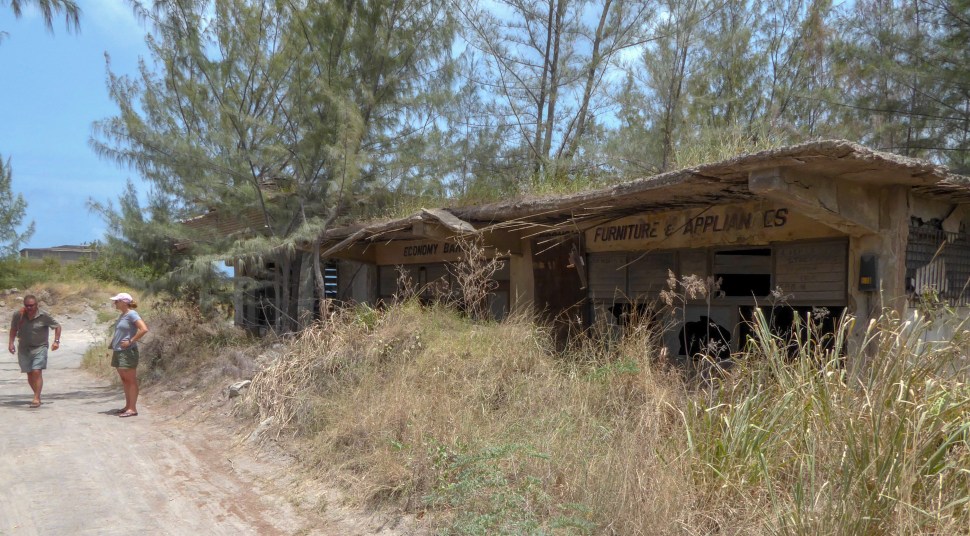
The police met up with us to open the gate to the Exclusion Zone, and we drove on to see Plymouth. Joe showed us before-pictures of the town, which was now unrecognizable. Four-story buildings were now two, and most buildings were completely covered. Here and there a roof was exposed, or the top of a church. With the exception of a street light there was no evidence of former roads. A dock had been drastically shortened, as the coast had extended with the pyroclastic flow. We were walking on top of a buried town. It looked like a war zone.


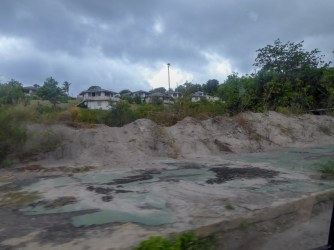
Outside of the Exclusion Zone Joe drove us onto another area where the land had extended the coastline, and he pointed back to where palm trees demarked the original line between land and sea. There were a few remnants of a beach bar, and we recognized what was left of a tennis court, cracked and worn.
Joe seemed slightly bitter about the inability of scientists to predict volcanic action. He alternately suggested that they know more than they will say and questioned why they’re on the island if there’s nothing they can do. In a video we watched, though, it was claimed that scientific discoveries have been made and instruments developed through the course of Montserrat’s recent volcanic history, including thermal cameras.

On July 12, 2003, a day he calls “Worst Event Saturday,” Soufriere erupted again, blasting 120 million cubic meters of earth material 10 miles high. Approximately 1.2 million tons of ash and pumice rained onto northern areas of the island. This was more than triple the amount accumulated between 1995 and 1998. (All of this also comes after Hurricane Hugo devastated much of the island in 1989.)
In his brochure, Joe writes of a number of things to observe about the island, including “The resilient residents building a new Montserrat,” and “That the residents are not confined to a little section in the north, but that more than 15 square miles of land is available for housing for the population of about 5,000.”
Joe drove us past a house that Jimmy Buffet stayed in, and he played for us “Volcano,” Jimmy Buffett’s famous song referring to the island’s volcano, recorded in 1979: “I don’t know where I’m a-gonna go when the volcano blows.” Buffett altered the song post eruptions, adding the line, “We’ve got to help our friends in Montserrat.” I learned that the recording studio boasted recordings from an impressive list of artists, including Elton John, The Police, Duran Duran, Michael Jackson, Stevie Wonder, The Rolling Stones, Lou Reed, Dire Straits, Paul McCartney, Eric Clapton, and Black Sabbath.
Our focus wasn’t entirely on the volcano. Along the way we stopped for bay leaves on the side of the road, and we made another stop to drink spring water (once you drink from the spring, says a sign, you will return to Montserrat). We stopped at the house of one of Joe’s friends and picked mangoes—we giddily walked away with more than 20. We learned that breadfruit, which grows on trees, is a cheap substitute for potatoes, and Joe explained how to cut, peel, and cook it.


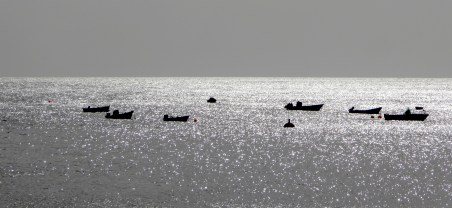
We enjoyed food and drinks at the Time Out bar and grill, where we could look out on our boat in the bay. (Aside from the local beer, we were offered Coors Light and Old Milwaukee.) Then for a snorkel before evening set in.
We stayed just two nights in Montserrat—early Friday morning, we sailed northeast for Nevis.
 Learning the Language
Reblogged this on Living on the Island of Montserrat.
LikeLike