Six Weeks of Sailing
June 27 – July 1, Dominica
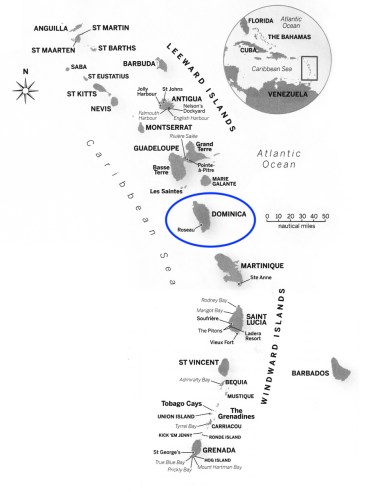 Welcome, my friends! It’s a common refrain, and it’s sincere. As we motor up to a coastline or into a bay to moor or anchor, we’re often met by someone in a small boat with lots to offer—help to hook to a mooring ball, fruit, ice, a buffet delivered to the boat—and truly, sometimes, it seems (like with Calvin Klein, from our St. Lucia post) we’re friends even if during that short interaction.
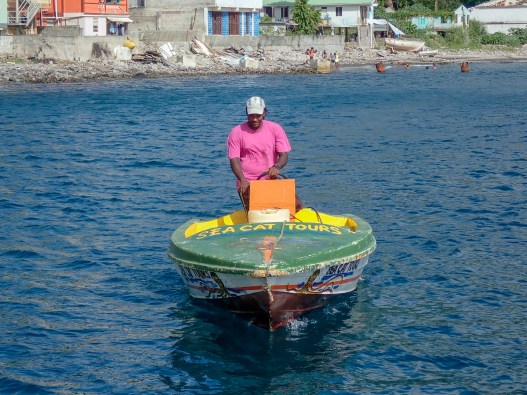
In Dominica, we were met by Mr. Beanz, a 26-year-old with an infectious, wise perma-grin, as if he already knows the punchline to life’s joke. I still regret mentioning to Jeff in front of Beanz that I was worried about the integrity of the mooring that he led us to after our hours-long approach. The ball was a blue tarp tightly wrapped around probably plastic jugs with thin line. It turns out that the mooring was Beanz’ own, and he free-dives them himself to check their dependability. After my comment, Beanz said, “It’s a beautiful ball, my friend.” And it was.
In his Leeward Islands cruising guide, Chris Doyle notes that Dominica might be the only island Columbus would recognize if he were to return today, as it is the most unspoiled of the Caribbean islands. Doyle writes that when Columbus tried to describe the island’s topography to Spain’s King Ferdinand and Queen Isabella, he finally crumpled up a sheet of paper to illustrate the peaks, valleys, and gorges. I’ve read that the people of Dominica have not been keen on developing the lush island as a hub for international tourism. Dominica has a population of 70,000, and socioeconomically, it is probably the lowest of the islands we visited. Thanks to the people and the hiking, Dominica was definitely among the highlights of our trip.


We stayed off the coast of Roseau, the capital, for four nights, and Mr. Beanz and his boss, Sea Cat, took good care of us in that time. Thanks to sailing vlogs and our cruising guides, we knew of Sea Cat (whose given name is Octavius) before we even set sail, so it worked out well for us that it was one of his guys who greeted us as we motored in. In low season, following a devastating hurricane, few people are making money off of yachty tourists.
As we waited for customs to open our first morning, we watched a young man snorkeling near our boat, doing some sort of free-dive fishing, dragging behind him a net bag buoyed with plastic bottles. We would see him periodically during our time moored off the coast.
Once we were cleared to step foot on land, we immediately headed back to water, scuba diving with Dive Dominica (a fun and solid crew). We dived off the southwestern coast of the island at Scotts Head Reef, where there’s a joke of a reward for finding Scott’s head, and just off of Champagne Beach, where bubbles rise from underwater vents. A few highlights included some lettuce sea slugs, a sharptail snake-eel, squid, and an electric ray. I love arrowhead crabs, and they are both everywhere and hard for me to capture well in a photo. The one pictured (in a mediocre shot) below is eating a fish. We toasted with the local Kubuli beer to Michelle’s first dives as a certified diver! (I’ve finally reposted with edited images–after losing my computer to Neptune, I wasn’t able to edit photos during our voyage.)


That night was the only time we made it to land with our own dinghy, and it took us a long time to find a dock that was still above water and that was low enough that we could reach it from our little boat. It was a fishermen’s dock, tucked in, and it was farther north than we wanted to be. A dreadlocked, older guy named Thomas helped us out of the dinghy and led us to a cool restaurant, Green House Sports Bar & Grill, where we met a waiter, Nakeem, who was beside himself to talk with fellow divers. The sun sets early (and quickly) in the Caribbean, and we used headlamps to get back to Albaran.
Our first land adventure, the next morning, was to hike to Boiling Lake with Sea Cat himself. It was the most memorable hike I’ve done. Before we got out of town Sea Cat stopped the van three times, all, it turns out, in search of eggs. Since the hurricane, eggs have been few and far between, not something one can find in a store. (Though Jeff will note that there were still chickens running around on the streets and roosters waking us up in the morning.) As Sea Cat drove us over and around steep hills spotted with homes and cars and people walking, he hollered and honked greetings along the way. At one point a man shouted out to him, and Sea Cat excitedly changed gears and reversed a bit up the steep hill. The older, semi-toothed man had limes, and he wanted to share them. So many things were scarce on the island. Sea Cat promised to pay for the limes later. And then there were a couple older men in uniforms who reached out and handed Sea Cat some arugula-like greens for our lunch—they knew Sea Cat would be coming by, they said, and he added the small bunch to his pile of spoils.


Sea Cat was in no rush; he was happy to spend however much of his day he needed to to give us the hike of our lives. We hiked our way from rain forest to mountain forest to elfin forest.

Along the varied terrain he paused to talk about this or that tree, and I admired his reverence for the flora that surrounded us—the waxy purple flower, the myriad ferns, the gum tree, from which he pulled some of the white, sticky substance to rub on his hands. He laughed as he swept his arm across the view at an overlook, presenting “50 shades of green.” He stopped at one viewpoint and peeled us green-tinted oranges, and then at another to dole out rum punch (which he insisted was really rum punch until we asked him about the recipe when he took us to the store after the hike).


Sea Cat said that the hike was somewhere between 7 and 14 miles, and we guessed it was around 10. Roundtrip took 7.5 hours, and that included lunch, a couple of waterfall stops, and some technical hiking—we were often hiking through water, scrambling over small boulders, and even lowering and climbing using ropes—in addition to the many other flora and fauna stops along the way.


We climbed down into a valley—the Valley of Desolation—which felt apocalyptically barren. The terrain is mostly shades of orange, with black streams merging with white. Steam rises up from 50-some vents in the surface, and the smell of sulfur wafts in and out. Streams of water run this way and that, but for the unfamiliar hiker it’s hard to know which streams are cool and which are hot.
Sea Cat had run ahead of us, and when we reached him he’d just placed five eggs in the hot sulfuric streams of water. While we waited for the eggs to boil (he asked how we preferred to have them cooked), he walked up to me and started painting my face with a hand full of gray-green clay. Jeff and Michelle were next, and Sea Cat finished with his own face, explaining how it keeps him looking so young (he now puts the mask on his neck as well). Most of the eggs escaped Sea Cat’s plastic bag stewing in the hot water, but the one that was rescued was delicious (and had a blackened shell). The masks stayed on for the next couple of hours.


We climbed back out of the valley to complete our hike to Boiling Lake, the world’s second largest active boiling lake (second to Frying Pan Lake in New Zealand). The lake is 200 feet across and holds temperatures between 180 and 197 degrees Fahrenheit at its edge. The lake is a flooded fumarole, which is an opening in the Earth’s crust (often around volcanoes) that emits steam and other gases, like carbon dioxide.


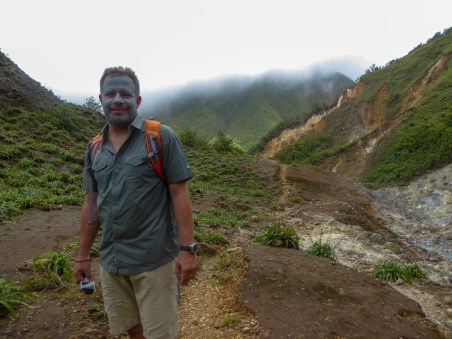
We sat on the rim of the crater and watched the center of the gray-blue lake far below as it rumbled and boiled, with a waterfall to the side as part of the view. We dined on a feast of a lunch that Sea Cat pulled out of his small pack: salad (including the greens acquired on the drive), baguettes, cod, fried plantains, and more rum-less rum punch.
Not long after turning back, Sea Cat went ahead while the three of us stripped to our skivvies and enjoyed a small waterfall and its pretty pool. We then scrambled up all the wet rocks we’d scrambled down, pulled ourselves back up the ropes, and hiked back through the three types of forest we’d journeyed through. Sea Cat took a special fern, laid it on our arms, and smacked it, releasing its white powder as a tattoo (it looked especially cool on his dark skin). We got a few glimpses of a jaco parrot, but the sisserou parrot endemic to Dominica eluded us.


At the bottom of the trail we were treated to a swim in a gorgeous slot canyon, Titou Gorge, with yet another waterfall as its source. An amazing day with some pretty cool people.


Sprinkled throughout our conversations with Beanz, Sea Cat, and Armstrong (below) were references to the hurricane that hit last September 18. Really we couldn’t begin to comprehend what the island had gone through—65 people were killed—and we tried to imagine the coastline that Beanz described and the trees that were no longer in the foreground of Trafalgar Falls. The dinghy docks had almost all been torn apart and strewn underwater, save for the stubs of pilings that stood as relics—we struggled to get to land without Beanz as our water taxi. Bananas are at the top of Dominica’s economy, and the banana trees were destroyed. It takes nine months for a banana tree to grow and produce a bunch of bananas; that feels quick to me, but for a country whose economy depends on the fruit as its top export, it’s an eternity.


Tourism is down, roads are crumbled. We saw evidence of the hurricane while diving as well; there was a lot of dead coral in shallower water. The guys in the dive shop tried to strike a balance between wanting us to know how much more stunning the diving used to be and encouraging us that it’s still a beautiful place for us as tourists. I’ve found this to be a common refrain in places hit by war or natural disaster.


Our last full day in Roseau, Armstrong (another of Sea Cat’s crew) took us to Trafalgar Falls, a popular tourist stop that we had to ourselves. But we continued past the wooden walkway, walking through the water and scrambling over slick boulders. Again we were in water that was in some places hot and some places cold, and Jeff and I continued up to the highest pool under a roaring waterfall. There are signs warning of the risk of flash flooding, and Armstrong said to watch for leaves in the water—they are an indicator from upstream that a flood may be on the way. Along the way Armstrong showed us where to step—he knew which rocks both above and below water were solid and which were the least slick. Getting out of the waterfall pool, he led me by hand with his swim trunks riding low, and I watched where he placed his feet, clad in transparent white jelly sandals.


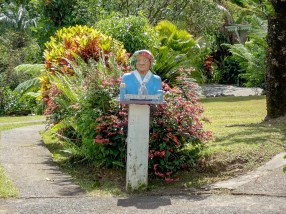
On our drive from and back to town, Armstrong periodically stopped the van in the middle of the road to pick us cinnamon leaves, to show us a bust in honor of a woman who lived 127 years, and to show us where the prime minister lives. Thanks to the steep hills, Armstrong replaces the brakes on his van once a month.


The service by Sea Cat and his crew was tops. The men were not on a clock; they were available at any time and for however long it took. Sea Cat picked up two rounds of our crew at the airport on the other side of the island and delivered them to us. Beanz never gave us a charge for all the taxiing, we just handed him some bills in appreciation at the end. And toward the end of our stay he joined us on board a few times for beer and munchies.
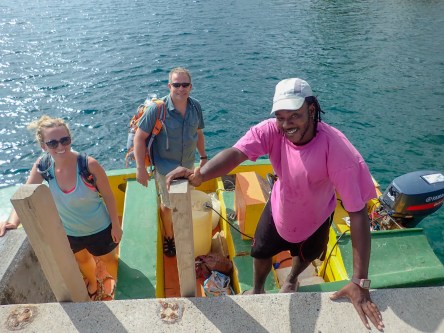 During one of those times with him on our boat, Beanz described his business acumen and his method for acquiring customers. For us it literally took hours to motor at 3-4 knots across the latitude line that we’d made it to, but for Beanz, he said, the time went quickly once he spotted us as he sat high on the hill working construction with a friend. He made it down the hill, caught a ride, and got into his boat to ride far out to meet us to make his claim. His business, he said, is all about attitude, facing the right direction as you sit on the hill, wearing a smile in front of customers no matter what your state of mind, and having the mindset that you will get each yacht that comes through if you put your mind to it. Beanz and Sea Cat’s whole operation were a class-act, in a unique Dominican way, and it was hard to say goodbye. (Actually, we just said we’d be back—that’s our hope.)
Ann, Lisa, Scott, and Kim joined us in Dominica, and we set sail the next morning for Iles des Saintes in Guadeloupe.
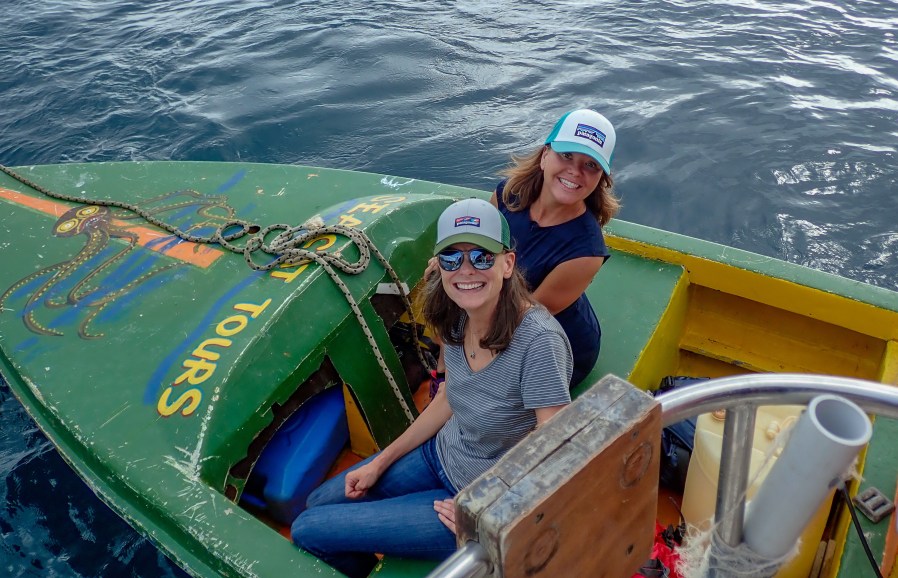
Check out our next visit to Dominica, four weeks later.
 Learning the Language
One comment