Six Weeks of Sailing
June 27: Marigot Bay, St. Lucia to Roseau, Dominica
A Full Moon, Dolphins, and Hours Upon Hours of Watching the Water
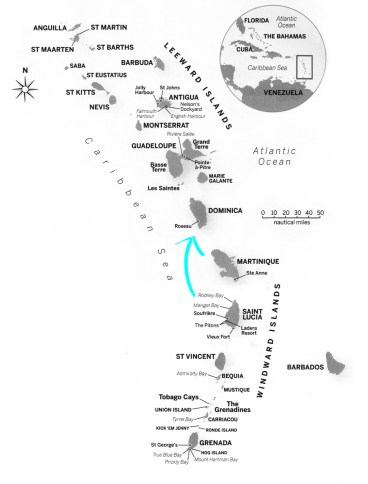 At 2 a.m. Wednesday morning we motored out of the Marigot Bay harbor to sail north to Roseau, Dominica. The conditions varied as we moved out of the lee of St. Lucia a couple hours into the journey. The winds accelerate between the islands, so as we crossed the space between St. Lucia and Martinique and then again between Martinique and Dominica the seas became “more lively,” as Jeff put it. The boat rolled across the waves, heeling (leaning) to the port side, occasionally dipping the toerail at the edge of the deck almost into the water and frequently taking water crashing over the bow.
It was an almost-full moon, and the reflection of light shone as a band across the water from the west. The moonlight on that western horizon gave me something fixed to ground my proprioceptive system. The voyage took us 14.5 hours. Over the hours we watched the moon set to the west and the sun rise in the east over the distant outline of Martinique’s mountains.
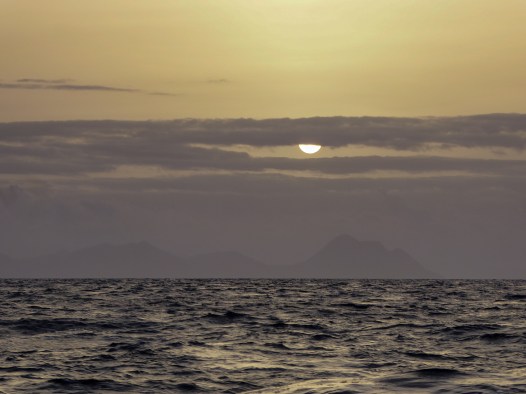
We saw one island disappear and then another in the distance, and the sun continued to move across the sky. The sail was the longest I’d done, and aside from occasionally grabbing some water or sunscreen, or helping to reef or pull out one of the sails, I just watched the water.

Michelle slept (or tried to sleep) in her cabin below the cockpit for big chunks of the journey. She reported later that some of the bucking and rolling of the boat was making her nervous, and one lurch in particular during the still-dark hours gave her pause. But when she heard Jeff let out a gleeful “Whooo, dog!” from the cockpit, she was reassured. “Whoo, dog!” has become a common refrain: We’re riding the waves in paradise.

We were joined mid-morning by a large school of dolphins on the bow for probably five minutes. Jeff estimated that there were 30-40 of them, and they leapt through the waves on both sides of the bow. I read somewhere that their preferred speed, to hang and play at the bow of a boat, is around seven knots, and we were just under that. It made what was a very cool day even more special.


We did struggle with the wind throughout the day. The normally reliable trade winds from the east were coming from closer to north, from exactly the direction we wanted to head. Modern sailboats, and monohulls even more than catamarans, can sail as close as 45 degrees into the wind. But we had the wind on our nose and couldn’t sail the direct line to Roseau. So we sailed northwest to the correct latitude and had a long few hours motoring east to get to land. Later, as Jeff backed up in the process of mooring, a big chunk of Sargasso weeds floated away from our boat. We’d passed through many ribbons of it along the voyage, and he guessed that the now-pervasive weed may have built up, clinging to our keel and slowing our approach.
There was one major damper on the day. Sometime after dawn I went into our cabin to grab my rain jacket, and as I climbed back into the cockpit I realized the jacket was a little wet. I’d kept it stored in a cabinet above our bed, and those cabinets and the shelves below were where I kept most of my belongings. I dashed back down to our cabin to open the other cabinets and found standing water in most of them, and water sloshing back and forth over the shelves below (which have high lips to hold things in). The big loss was my computer. So four days into my six-week trip, I lost my trusty Macbook Air to saltwater. With it I lost my first blog for the trip, almost ready to post. And so from the beginning I’ve been behind, and my posts will be abbreviated and photos unedited, working from a borrowed computer when it has enough charge—among the challenges of blogging and working with photos on a boat.
We arrived at 4:30 in the afternoon, missing customs for the day, so we weren’t able to get off the boat until Jeff was able to clear us in the morning. Before we finally reached the coast, we were met by “Mr. Beanz” and his younger companion who drove his boat. The pair said they’d help us moor, and they cruised back in to wait for us and guide us to one of Mr. Beanz’ buoys.
After we got set up with our mooring ball, I got to work starting to clean up my saltwater mess. The only clothes I had that were not soaked in saltwater were the clothes I was wearing (and sitting in the cockpit, those got sprayed by the ocean periodically). If you’ve had experience with saltwater you know that it gives towels and clothes a never-fully-dry, residued feeling, as well as a bit of an odor. It would be over a week before I finally got the musty smell out of our cabin. All our spare towels and linens were soaked, part of our bed was wet, all my books and papers were wet, many of the vitamins and medications in my weekly pill box dissolved into a brown paste, and all of my cords, SD cards, external hard drives, and batteries were soaked. 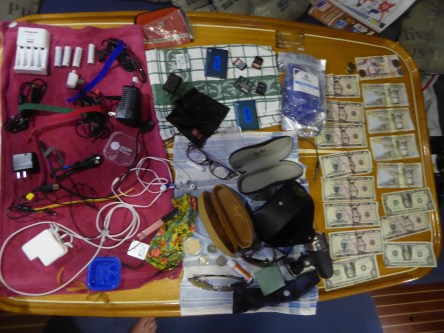 Michelle helped to lay out all of the papers, my wet money, and a variety of other things, and she laid sheets and towels from every bar and across every surface that she could find. We would be asking Mr. Beanz to take all of the sheets and towels into town to launder. It turned out to be five loads, costing U.S. $50. I should have sent more of my clothes in rather than just giving them a rinse in small douses of precious freshwater—that didn’t save them from the musty smell. Ironically, my scuba gear stayed dry, as it was up in the cockpit in a locker that could get wet.
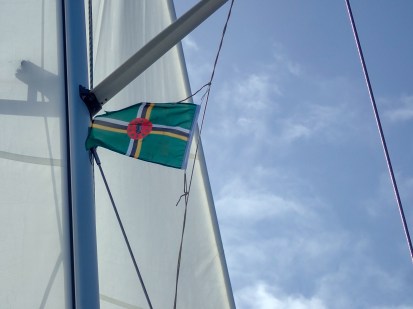
AND. I dealt with all of this while moored a stone’s throw from a coastline ravaged by Hurricane Maria last September. My soaked belongings and a ruined computer are simply an inconvenience—I’m extremely privileged, and I’m on the trip of a lifetime.
 Learning the Language
Beautifully written,Shannon! — Ye Ed.
LikeLike