Six Weeks of Sailing Begins
June 23-27, St. Lucia
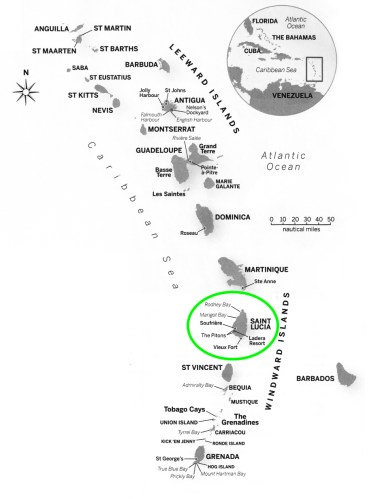
I took the hour-plus taxi ride from the Vieux Fort airport to Rodney Bay, where Jeff and Michelle had arrived a day earlier. Kenrick, my taxi driver, pointed out cocoa, almond, and banana trees, and explained that the soccer stadium near the airport had been turned into a hospital when the hospital burned some 8 to 10 years ago. Bananas are the island’s primary export, and he told me about banana ketchup, which he said had a bit of spice and I later tracked down. (Kenrick is moving to New Orleans this month. His in-laws have sponsored him and his wife, and they’ve waited 12.5 years for it to go through. He doesn’t have a job, but he says he’s willing to do anything.)
St. Lucia changed hands between the English and the French 14 times, gaining independence in 1979. Slaves helped to establish the island largely through plantations—cotton, coffee, and sugarcane. All beaches are public. The island has two signature conical-shaped peaks in the south.
Jeff and Michelle had done a complete inventory of the boat, and Ulrich, who manages the boat, came out to talk through discrepancies and explain a few things, like the capacity of the diesel and freshwater tanks. We spent the morning diving and then continued to provision and prep the boat. We had a wheelbarrow to haul tanks and food; we bought flags and navigational charts for a few places that they didn’t have already on the boat.
The store where we provisioned at Rodney Bay was the size of a small liquor store. My first time in I asked about the banana ketchup. The tall black woman, younger than me, had never tried it (and wasn’t interested in trying it), but when I asked about the West Indian hot sauce from the same company, Baron, she got very animated. “That is the shit!” she said, and insisted that we try it then and there. If she opened a jar and we liked it, would we buy it? Of course. So she cut up a cucumber and placed on it a few dollops—it was tasty and spicy. And then somehow mangoes came up. She got even more excited, and pulled out a Julie mango. This, she said, was the double shit, and we had to try it. She didn’t have any to sell us, so she gave us her own.
We returned to the store the next day to buy a bit more food to last a couple of days, and I was excited to find avocados. We got to the counter and a different woman, whom we’d also seen the day before, rang up our items. But when she got to the two avocados and a cucumber, she told us she couldn’t sell them to us because their scale was broken. Michelle and I were dumbfounded, and we were determined to figure out how we could walk away with these avocados. It seemed that our best option was that maybe later that day a scale would arrive; the woman wouldn’t let us pay a hefty amount to more than cover the cost. And somehow because we couldn’t buy the vegetables she had to start ringing up all our items again. But that caused a delay sufficient enough that our hot-sauce-and-Julie-mangoes-are-the-shit friend had made it into the store, and she came to our rescue. She found other items around the store to balance in her hands as a reference to guestimate the weight of the avocados and cucumbers. Success!
By the time we left Rodney Bay, Michelle was open-water scuba certified, through Scuba Steve’s Dive Shop. (Scuba Steve’s was pretty organized, and the guys were for the most part friendly and solid.)


The photos above are from Lesleen “M” Wreck and Anse C in Anse La Raye.
We’d placed our food and brand new scuba tanks in the wheelbarrow and wheeled over to Albaran. We were provisioned, we had tanks, we’d practiced drinking local beers and fruity rum drinks—we were ready to set sail!
We sailed a little less than two hours south to the Pitons, and we moored between them, just around the corner from the town of Soufriere.


We were approached by two young men in a small boat, Johnny and Joel, whom we’d continue to see until we left the following day. They helped us hook up to a mooring ball, and they pushed us hard to sign up for a hike with them to the Petit Piton the next morning. After Michelle did a bit of research, though, it became clear that Gros Piton was the one to hike—the boys had tried to dissuade us, saying it was just run by rich white men trying to make money. But Petit Piton was described as dangerous (I’ve since read that it’s illegal to climb), and I certainly did not trust the boys—they were not particularly friendly, and I didn’t expect that safety was a priority. But when we saw them that evening we did ask them to drive us over to the trail head the next morning.
Not long after Johnny and Joel helped us moor, we had a couple more visitors in small boats offering services (a common practice, particularly in less developed areas). One older guy was selling fruit, and we bought a pineapple and a papaya. He was wearing something like boxer briefs, with his (probably dreadlocked) hair back in a large stocking-cap sort of hat—I don’t know the name of it, but it’s a common sight in the Caribbean. Over his dinghy motor was a periwinkle blue polo shirt, which didn’t seem to fit his style—except that it did, on his motor. He’s one of those guys who’s gregarious, immediately everyone’s friend, and probably quite high. Through watching sailing vlogs and reading guidebooks, we’ve learned that the nicknames for Caribbean characters can be pretty interesting. In honor of his underwear, Jeff dubbed this guy Calvin Klein. (We’d be spending a bit of time with a few more delightfully nicknamed blokes in Dominica.)


The boys picked us up the next morning, and we were chugging along slowly enough with five in the boat that Johnny dropped Joel off on some rocks to lessen the load before driving around the corner. We paid the steep $50 U.S. each for a guide, Kacy, to hike the 2,529-foot peak. (Petit Piton is 2,437.)
As do most volcanic peaks in the Caribbean, the Pitons have an interesting history. The Arawaks worshipped them as gods. The Gros Piton was their god of fire, thunder, and rain, and the Petit was honored as the god of fertility, food, and manioc. When I read the following, it was among the many times I’ve been unable to comprehend another culture and time in history: “A local historian, Robert Devaux posits the view that the Arawaks believed that the spirit of their Gods slept in the boiling springs of the Sulphur Springs while the Carib settlers viewed the Sulphur Springs as a God and worshipped it by throwing in virgins to appease the God during periods of intense hydrothermal activity. For that reason the area was known as, “Qualibou” meaning, ‘at the place of death’” (from http://soufrierefoundation.org/about-soufriere/history).
It took us more than four hours roundtrip, and Kacy introduced us to many of the trees and gave us some history (including showing us a trail formerly used by slaves to carry goods from a plantation). Toward the bottom of the trail, mangoes dotted the path like breadcrumbs. Kacy rotates with 12 guides, and I was pleased to see that many of the other guides on the trail were women. We got to see a couple of hummingbirds, and Jeff got to enjoy a hoppy Piton on top of the Piton, thanks to a guy with a drinks/fruit stand a few hundred feet from the summit.


That afternoon we sailed up the western coast of St. Lucia from the Pitons to Marigot Bay, which turned out to be a pretty cool spot. The bay is tucked in farther than it looks—once you get in a little way you head around a little palm-tree-lined spit, which then opens to a quaint, happy, protected bay. Lore has it that in times of war fleets of ships hid back in the bay, disguising their masts with palm fronds.
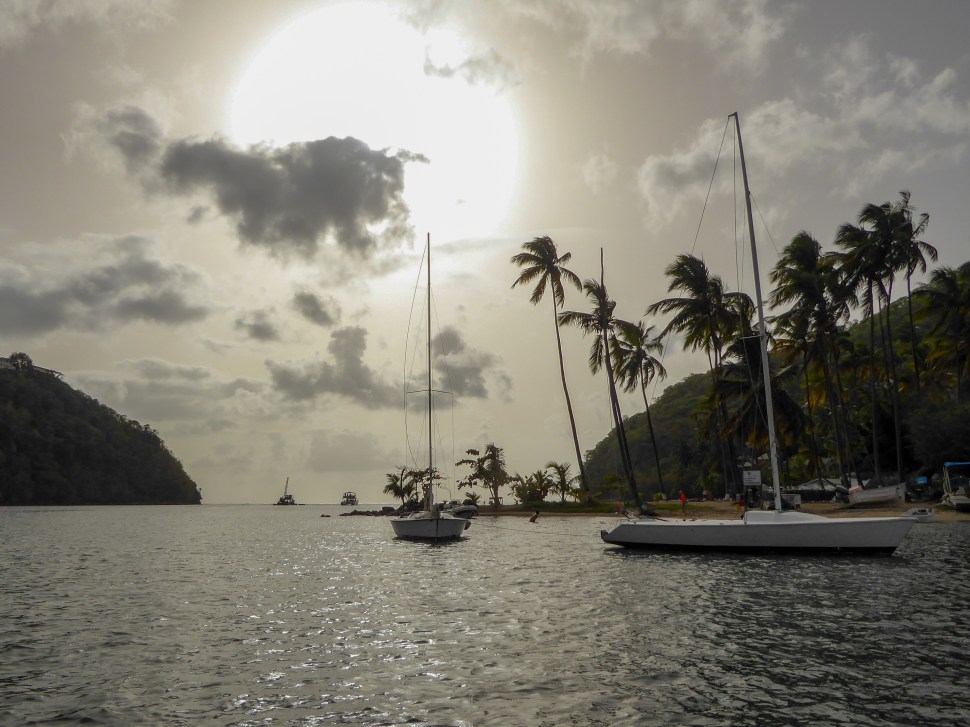
Jeff checked us out of customs in St. Lucia when we arrived in Marigot Bay, because we would be leaving for Dominica, two islands north, in the middle of the night. It turns out that by mooring in the bay (paying U.S. $20), that you are a guest of the hotel, and that meant for us that we got to enjoy a swim-up bar at a large, curvy pool (also open was an infinity pool a level below). Jeff hopped out of the pool for a quick job interview by phone, in his swim trunks, with a Piton beer in hand and a big smile on his face. We couldn’t believe our luck of cheap luxury and joked about our “camping” lifestyle.


Being hotel guests also gave us access to showers, and Michelle and I took advantage of the chance to wash our hair with freshwater. We enjoyed some tasty umbrella drinks at Hurricane Hole, which also had good food and friendly service, before trying to catch a few winks before our early sail by moonlight.


 Learning the Language
Awesome!! Thanks, Shannon! Can’t wait to get down there!
LikeLike